This week has seen better progress on my book. I got six pages done! Really happy with my how it’s turning out. It’s amazing how achievement changes the way the world looks. Also, I’ve been reading Demon Slayer on my breaks at work, and I’m close to the chapter 100 mark. It’s good so far, but I don’t like how little Nezuko gets. In theory, she’s a main character, but she’s literally stuffed in a box most of the time, and only gets out when she disobeys orders to prove she should be out there fighting all the time, and somehow got stronger. Her lack of character development and character getting-to-know-anything-about-her-at-all is disappointing.

This week, I want to talk about a different manga, Doughnuts Under a Crescent Moon by Shio Usui. The last volume came out this week, and it had a strong ending. Our main characters got to meet up and resolve all their major roadblocks and concerns. I want to reread the series again soon because the ending also saw our heroines come out as asexual, in less specific terms, and I don’t recall that being a part of the story before. The only mentions of physical intimacy that I remember are when Hinako dislikes men getting close with her, which I assumed related to her being a lesbian. The rest of the story made sense to me under that assumption. So I want to go back and see if and what I missed.
This confusion on my part brings to mind something that I tend to be annoyed with in reading yuri, which is that there’s often very little, if any, contention with what this love means about the characters and their relationship with the world. In my experience, it’s not common for a yuri story to include a storyline where the main character grapples with what it means to be gay in a homophobic society, or even a moment where the character acknowledges that they are gay in the general sense. It’s much more common for the story to focus solely on the relationship and have some line about how, “It’s not about gender, it’s about the person.” And like, no, no it’s not! Gender does matter, and saying it doesn’t is kind of a cowardly way of not facing your new reality. Like, I don’t want to sound like a jerk; people need time to feel out their feelings and determine what best fits their own identity. I’m annoyed that that part is rarely seen in yuri stories, despite how long the romance can take to develop and how much time we see the characters exploring their own emotions in relation to the one person they crush on.
I think there’s likely a “show, don’t tell” rationale behind this trend. There’s also the legacy of SS novels in modern yuri fiction, and older ideas in Japanese culture, where I understand it was commonly thought that girls liking other girls was a common youthful experience that ends at adulthood (please correct me if I’m wrong there, I read it online). That said, I think it’s better when characters have enough knowledge, experience, and courage to say what they are. Not because I could be confused about how they identify, but because how they identify matters, and seeing people say it out loud is important in storytelling. There are young people reading these books who are looking for something to relate to their own lives, and seeing someone have the courage to proudly state their identity can be very important for them. And beyond that, yuri stories are very commonly about women discovering their love for women and coming to terms with it. They’re literally the stories where we should be seeing them come to terms with their identity and their relationship with the world! Asexual representation, in particular, is important, and having more direct and concrete statements about being asexual and what it means is important, given how underrepresented it is. Doughnuts had a good opportunity to be more open and direct about a subject that’s mostly overlooked and assumed not to be the case, or even real, and I think Usui should have taken it.

That’s why I like the stories that do grapple with these ideas. NTR: Netsuzou Trap by Kodama Naoko is a great example. Her art is stunning, and I’ve always been taken with the clean, modern panel layouts. The most impressive thing is how the main roadblock for Yuma and Hotaru is Yuma’s internalized homophobia. From the start of the series, Yuma’s main concern was if people saw them together; if she didn’t have that concern, things would have progressed much more quickly for them. Over the course of the series, everything we see about Yuma’s internal struggles with her relationship with Hotaru are really about her rigid understanding of the world and her place in it leaving no room for a romantic connection, despite feeling one intensely. Yuma learning to accept that she loves women is an important and integral portion of the conclusion, a necessary step that we see her slowly work towards so she can be with the one woman she loves right now.
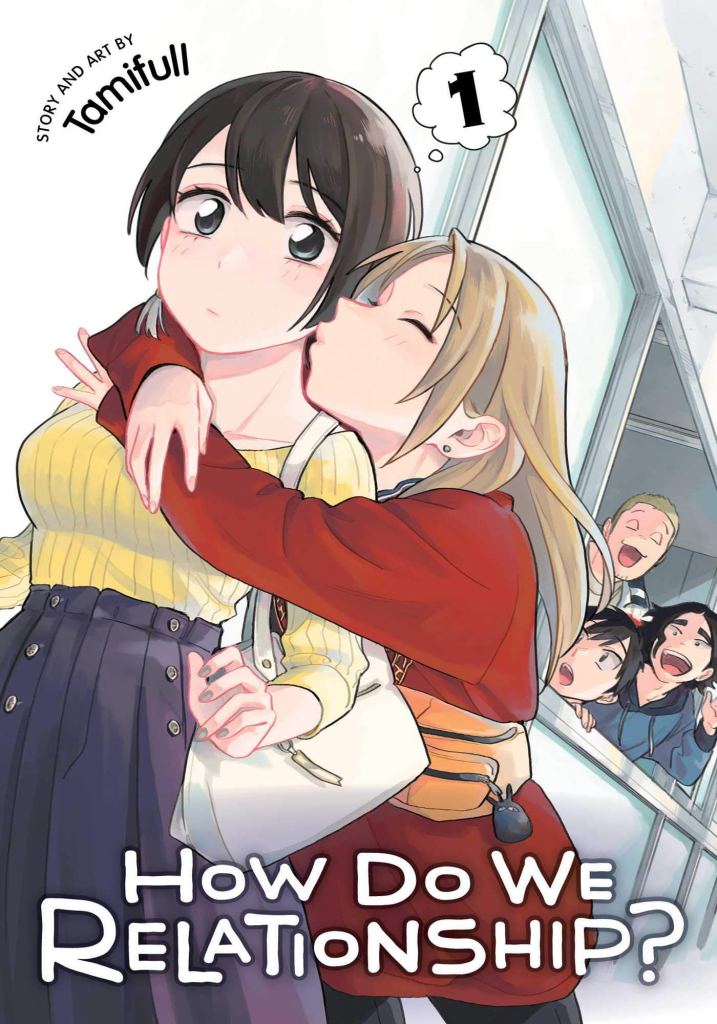
Other good ones include How Do We Relationship? by Tamifull and Yuri Is My Job! by miman. HDWR is a great book because it’s a romance that starts with the characters dating, instead of treating dating as a happily ever after. That being the case, both characters know how they identify from the start, and their concerns with how to be seen in the world and who to tell are prominent struggles for them. We also see other characters in different parts of their journeys to their own identification, which provides a varied group of perspectives and experiences.

YIMJ is a true masterpiece book; every panel has like five meanings. Our main character, Hime, is completely dense and struggles in every way to figure out how she feels and what she wants her relationships to be. Nine volumes in, she still hasn’t figured out she likes women. There’s a public bath scene that I really like, where we see Hime really look at her friends’ bodies for the first time and she clearly thinks they’re all hot. It’s not just Yano! And right now, we’re in a break from the Hime-Yano story to focus on Kanoko-Chibana, and it’s clear that they both need to open up their minds. Kanoko is slowly slipping out of her tunnel vision for Hime so she’s back to knowing she’s a “bad girl,” and there’s clearly some history with Chibana and, I’m guessing, every girl she’s ever been close to that Chibana needs to reconcile.

Oh, I shouldn’t forget Even Though We’re Adults by Takako Shimura. Really fantastic book with 35 yo protagonists. Ayano and Akira’s stories are entangled together, but they are separate journeys. Ayano’s big struggle throughout the book is coming to terms with her bisexuality, backtracking her relationships to figure out what she was overlooking, and trying to determine why she ignored it. It’s a wonderful storyline to see play out on the page, and especially so with an adult well into her life, rather than a teenager. I’m always looking for more adult yuri stories; not everyone has things figured out as a teenager.
As I praise these particular books for their subject matter and presentation, I do want to say that they still don’t always have characters say how they identify. NTR does have Yuma take on the mantle of “lesbian,” albeit in an “I’m still not out of my internalized homophobia” way, and HDWR and ETWA do have the main characters either identify or directly talk about their attraction. YIMJ still hasn’t had any of these shy, guarded characters directly say it, which is really fitting given how the setting is constantly hitting them over the head with the obvious while forcing them to pretend it’s not. The thing they have in common is that they’re dealing with the issues of identification head-on, as a part of the romantic development, rather than making a big deal about their one true love who’s special and different and goes beyond gender. That’s the kind of thing I want to see more of in fiction.
 Life in the Gutters