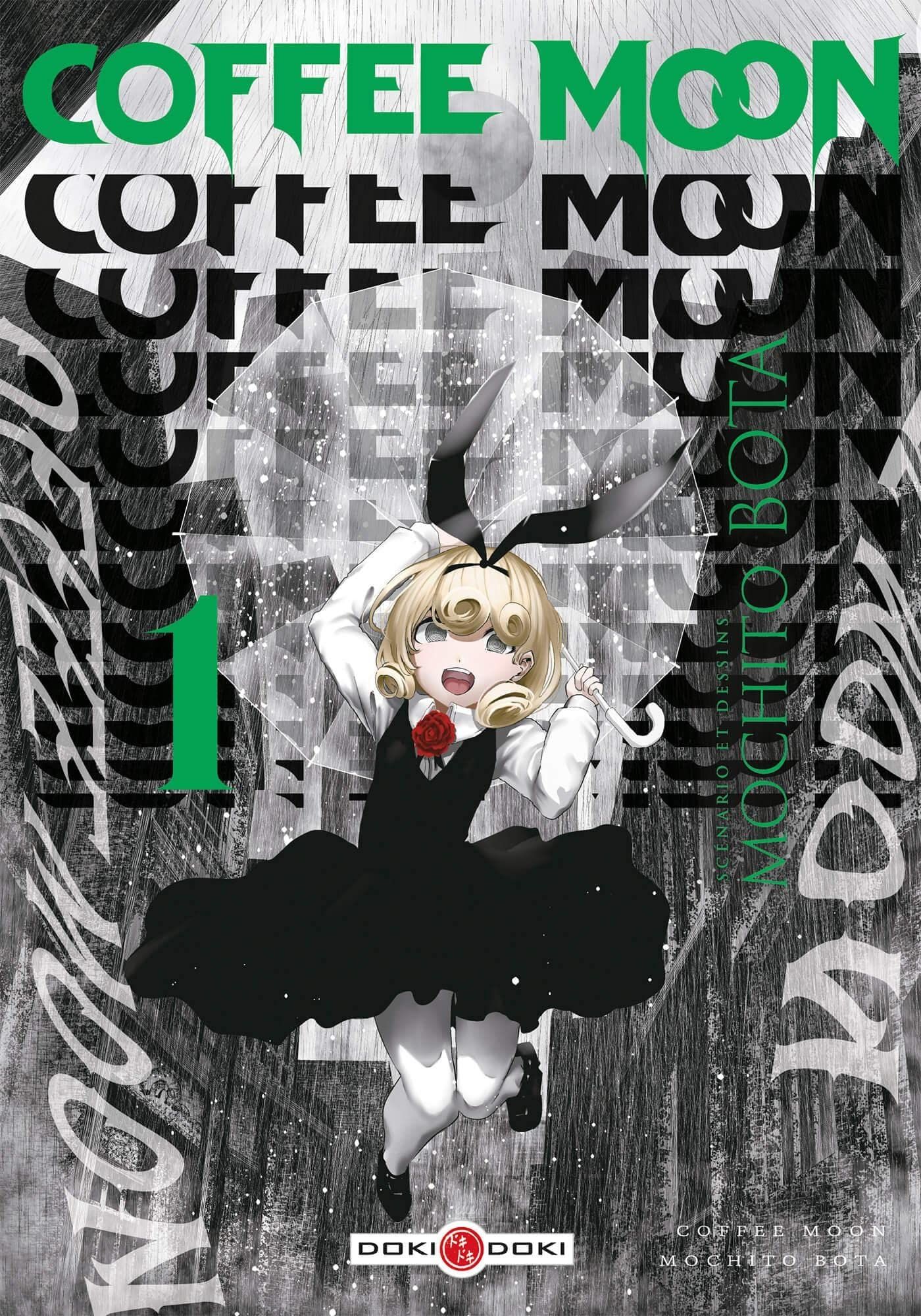

COFFEE!!! MOON!!! Coffee Moon! Two words, people: COFFEE MOON!!! I’m so excited for this week’s topic! But more on that in a second. It’s been a kinda strange week for me. I feel like it went by in a blur. Work has been slow, but also I didn’t get much done? At least not compared to what I wanted and should have been able to achieve. My real work is coming along great, though. I’m in the middle of my process for the final page of my next comic! I want to redo the cover, and then it’ll be ready. I’ve learned a lot from this process, and I’m looking forward to my next project and all the practice and study I have to do in between.
Ok, onto the main topic. As you can tell, I’m very jazzed about Coffee Moon by Mochito Bota. The second volume came out last week, and I was immediately amped to write a post about my thoughts surrounding it. I realized that the direction I was initially planning wasn’t what I wanted to say, so here I am a week late on the subject. The story is about Pieta, a high schooler who is caught in a time loop of her sixteenth birthday over a thousand times, and the lesson she has to learn about happiness. It’s really great. I won’t get into spoilers, I think I can say what I’m currently thinking with just the first chapter.
The first chapter introduces us to Pieta and her time loop. We see her go through her morning routine, see through her mother’s excitement to celebrate that evening, experience a series of misfortunes on her way to school, receive a present from her best friend Danae, have an afternoon coffee, and then come home to her birthday celebration with mom. She’s been in this time loop over a thousand times and insists on going through the exact same routine repeatedly, no changes, because at the start of the story, she’s convinced that’s what true happiness is. She has everything that would make her happy, a fortunate life, and the people close to her.
Without getting into details, the later chapters see other characters join the loop and introduce various changes to the routine. Much of the story is about what deviations are good, what kind of happiness is best, what are the consequences of seeking out more happiness than your normal life allots, and the anxiety that comes from living a life so preoccupied with whether or not you’re happy. A big part of Pieta’s thinking in the story revolves around her understanding of the relationship between sadness and happiness. As a simple example, she sees her morning misfortunes as what leads to her happy birthday with mom. That’s part of why she has settled into her routine in this time loop, working to find meaning and joy in her mundane life.
I think, as the story is kind of moving towards, that there is something to the idea of finding happiness and wonder in mundanity. We are creatures of habit, we are hardwired to take a lot of things for granted. If everything is happening the way it always has, then it’s fine. Boring, even. Our brains don’t even process all of the visual information we receive because if it’s all familiar and the same as normal, it’s a waste of energy to actually see it right now. A lot of what you see in your familiar environment is projected from memory and expectation. Point is, it’s easy for us to assume that whatever we experience on a day to day basis is “baseline” or “unimportant.” As a result, we miss out on all the amazing things that are happening around us all the time, we forget that everyone has their own little adventures just outside of view, and that there is so much for us to enjoy and appreciate right under our noses. That’s why we’re supposed to practice gratitude and focus on the present, so we can break our normal rhythms and experience what the world is actually like.
I also think that, whether we’re conscious of it or not, many of us tend to believe in some sort of balance in the universe. We do good things, we should get rewarded; we had a bad morning, we should get a good night. Apophenia and all that jazz; we’re looking for patterns to events to construct our own meaning. We see Pieta struggle with this because she’s been caught in the same day for so long that she has this bird’s eye view of the consequences of her actions. She knows how all of her actions are connected to any changes to her birthday. When bad things happen, she feels the burden intensely, and lives in this heavily moralized world where her happiness is most important yet also most dangerous. That’s something that I have some experience with personally; obviously, I’m not in a time loop, but I do often worry about whether or not I’m being selfish, if I deserve to get the good thing, or if I’m just going to hurt someone. I’m sure a lot of us have that sort of experience, where you’re too scared about “messing things up” that you don’t reach for what you want in life.
I’ve been having trouble thinking out this post because it gets kinda cheesy, in a way that makes me feel silly. But I think it’s true. The world is an amazing, fantastical place. You don’t need to add any magic to the formula, just take a look at what’s there. The fact that any of this is happening, that we are where we are, is astounding. The possibilities for what this life could be like are infinite, and there’s so much more we could have than what we get. There are probably a lot of things in your daily life that you put there because you enjoy it, and it’s become so routine it feels bland. Before changing your routine (which would be fine), change your perspective. Try to reconnect with it, to remember what was so great about it at the beginning. Like, there’s the cliché that marriage requires you fall in love over and over again. I think life is like that; all the sparkle in your eye as a child is still there, you just have to find it again.
There’s a quote from How Do We Relationship by Tamifull, “Guilt is just another expression of your ego.” In my own life, I’ve found myself taking responsibility for things outside of my control so that I could feel like I was fixing a mistake, that my own actions would make up for or alleviate some harm that I imagined. It’s never a healthy thing to do, and admittedly, it can be hard to recognize what things are within our control or not. In general, though, it’s important for us to recognize that most of the world is beyond our reach. We are small drops in a big ocean. Realizing that cosmic lack of power is incredibly freeing, and allows you to focus instead on what you can do and what you want to do. There’s no point in feeling crushed because you can’t make the big change at work, when there are all sorts of other changes you can make. You’ll be happier for them, and one of them will lead you closer to your goal.
Even this advice feels bland and trite as I write it. It’s cliché, it’s obvious, it’s cheesy. Even the experience of not knowing that some piece of common sense was true until it happened to you is a cliché we can write off. But clichés exist for a reason. Like…here’s a thought exercise I thought of, one that’s probably been thought of by someone else in another form: Imagine yourself standing on a beach. Draw a circle around your feet in the sand. The space inside that circle is your mind, everything you think and feel and experience. Everything outside of that is the real world, so much bigger and more vast than yourself. It’s easy to confuse the former for the latter, and that’s a trick. Now imagine everyone in the world on that beach, each with their own circles. We all have this “complete world” in our circles, one that’s never a complete representation of the world. I don’t have a way to continue this metaphor. Point is that, while I’m not a big, cosmic Truth person, I do believe that truth exists in the world, and we have to keep looking for our small, personal truths. All these cliché lessons from the past are our ancestors telling us the things we need to understand in order to live a better life, and yet we’ll never understand what they’re saying until we recreate the chain of experiences that lead to the cliché. Well, and also understand that that’s what we’re doing. Life is a time loop.
So yeah, you should all read Coffee Moon. Pieta is struggling to find this balance for herself, and everyone could use a chance to consider their own balance in life. There is so much joy and wonder in your own everyday experience, and yet there’s also nothing wrong with trying to branch out and make your life into what you want it to be. When bad things happen, you make amends and learn not to take more responsibility than you have. Keep moving, keep trying, and work to understand the world others live in, for them and to better understand your own. Everything that seems normal now was once novel and amazing, it still can be, and it will be again.
 Life in the Gutters