I’m feeling kinda squirrelly right now. I have a better sense lately about why I’m not satisfied with what I’m making, and what direction to go in, which is nice. At the same time, though, because it’s a direction I haven’t gone in before, I’m moving in the dark. It’s harder to take steps when you aren’t sure where you’re headed, you know? I heard the phrase, “The hand cannot grow faster than the eye,” and I’d like to think my eye is growing right now. But that’s something you can’t really know without hindsight; in the moment, I’m filled with conflicting nerves and excitement, and the nerves are what’s winning out. I hate not knowing if something’s working for me.
On another note, I’ve been enjoying Marvel Snap lately. As a game, it’s very well designed, and I love hearing how much thought they put into it. I saw Yu-Gi-Oh slowly cannibalize itself until it’s become this frustrating exercise in skirting around the rules instead of playing the game as intended, so seeing a much simpler game that is leans on the mechanics and keeps overall fairness in mind is really great.
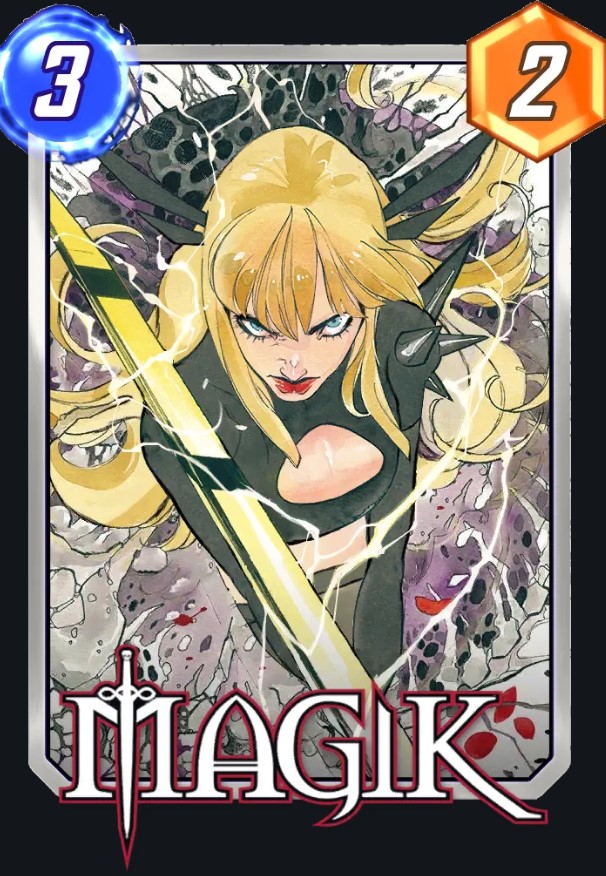
It’s also pretty cool to see how front-and-center artists have been in this game. For a while, I didn’t think collecting variant cards – versions of the cards with art by an artist other than Ryan Kinnaird, who makes all the base card art – would be much of a draw, but it’s growing on me. There are some really great variants out there, from a lot of great artists they’ve commissioned for the game, and it does add a level of coolness when you’re playing with the good variants. I was really won over to that camp by the Peach Momoko variants. She’s such an amazing artist, all of her variants are amazing and spot-on, and it’s such a treat when you see one pop up. I just got my first one today, her Namor variant, and it’s gorgeous. I see other players with her Magik (seen above) and Rogue variants most often, and they’re both perfect; like, I don’t have a deck that uses Rogue right now, but I would make one if I had the Peach Momoko Rogue. I’ve been collecting Dan Hipp variants, too, and I’d love to get some Rose Besch and Jen Bartel variants. These Flaviano Armentaro variants for this season are stunning; kinda sucks I don’t get more than two spotlights a week. I got the Kris Anka Marvel Boy, and it’s wonderful. I also love my Nikola Cizmesija Shocker; his Kraven and Electro are great, too, and I’m surprised they aren’t formally named either Nikola or Cizmesija variants.
Like, for as much as I think variant covers in comics are a distraction from the artistic pursuit of making and selling really good comics, the cultural idea of variants is perfectly suited to a collectible card game, and in fact is a major draw. Being able to make entire decks with cards by a particular artist or a suite of artists that you like is a great way to show off to other players and express yourself. Having this kind of market for artists is beneficial, as well, though I’d like to get some data on how much it’s helped artists’ careers. And it’s undeniable that the way the game highlights artists through season spotlights and shop takeovers puts their names and work in front of a broader, more casual audience. After all, while I’m sure a ton of comics readers are playing Snap, there are a ton of people, adults and kids alike, who have only seen the movies, played console games, or simply came to it fresh. All people who wouldn’t otherwise come across art by comics artists, who wouldn’t be familiar with these names or be excited when they have a new thing coming out. And the art they’re seeing are illustrations designed to highlight the charm and personality of the characters, which is a different muscle to see an artist flex than narrative comic book interiors.
I feel a little self-conscious saying all this without mentioning that I still have skepticism on how much the game developers are true allies of artists, and how much this helps artists. I don’t have any hard proof to back up the idea that this does boost anyone’s career, and it’s still all mass media, corporate-owned IP. They’re a business, art v commerce, all that anti-authoritarian jazz. I just really like seeing what they have done, because it’s more than most game developers. They interview artists during season launch videos, and at the very least, they’re kicking plenty of work over to great artists, who I hope get residuals beyond their initial commission. While I don’t know a lot of behind-the-scenes, the combination of their actions makes a convincing argument that they do care, just as they seem to genuinely care about making the best game they can.
Aside from all that, I also think Marvel Snap is actually a great example of the best way to use the Big Two’s common tropes of superhero comics, and why their copyright empires should fall. The issue of superhero characters being shuffled around like action figures doesn’t apply to a game, where that’s all they’re expected to be. The sales inflation of collectible variants (typically reserved for already popular books that’ll contrast with “books that just don’t work” after people spend five books’ worth of money on one) is just a great way to highlight artists and bring in greater attention to a game. Seeing a wide array of different visions from artists who won’t likely work on those characters also highlights how glorious the public domain superhero genre could be. Like, copyright abuse and elongation really needs to end a decade ago, and the fact this game gives us a glimpse of what that could look like would be ironic if it weren’t for the other fact that this game could exist in a public domain setting just fine.
Also, as I close this out, I just realized…does Peach Momoko’s name mean, “Peach Peach?” Because that would be very cute. I haven’t learned all the fruit names yet, but I’m pretty sure peach is momo.
Weekly Art Blog 8/11-8/17/2024
 Life in the Gutters