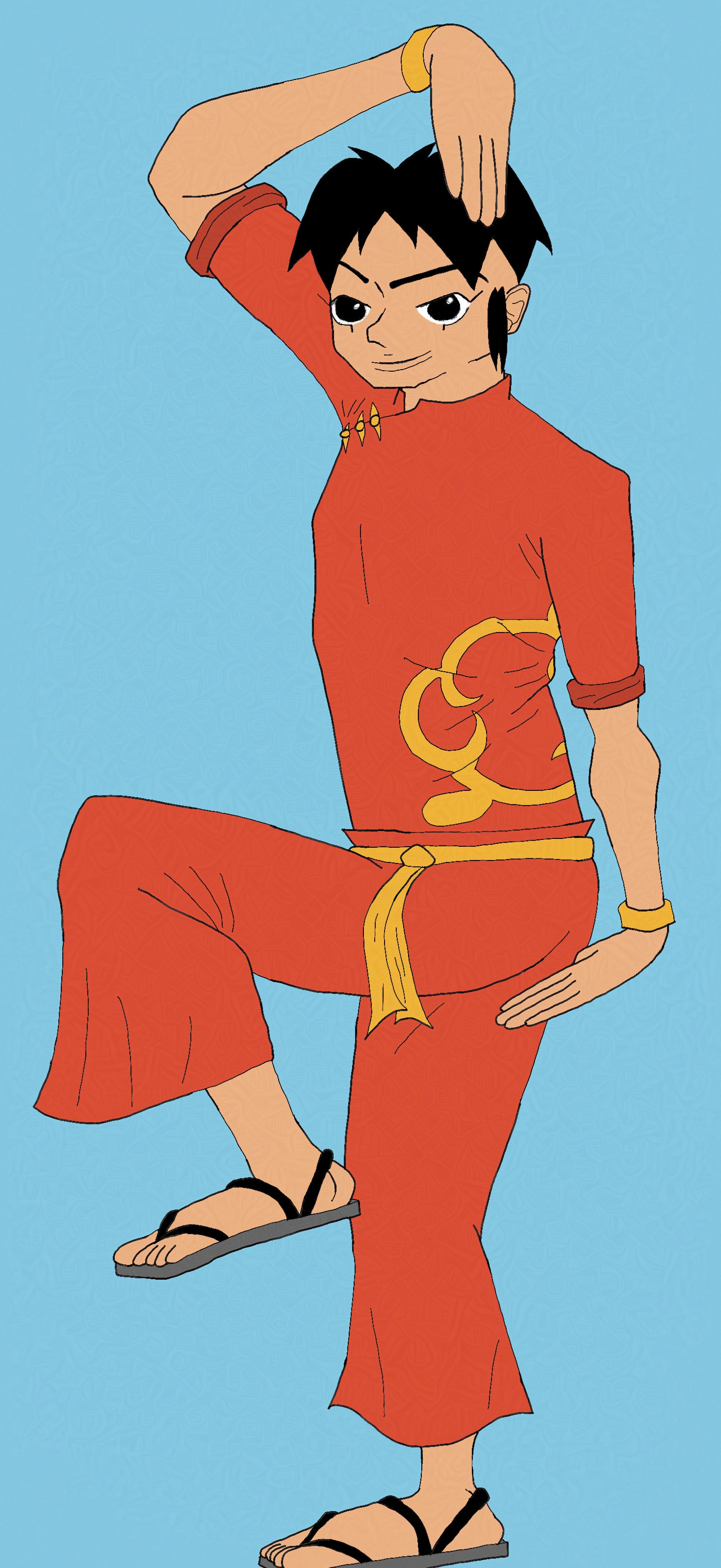
This week, I finished up another Hajime pic. They’re in a crane block pose. It’s one of those more fanciful moves you learn in martial arts that you almost certainly won’t use in a fight, but there’s principles of movement involved that you do need to know. I had some trouble initially with putting the pose together. I thought the angles for the torso were complex enough that I could learn more about how to position the torso box in a shape figure, but in the first couple attempts it just wasn’t coming together properly. I knew the pose in my head well enough that I thought I knew how everything should be positioned at that angle, and then I checked in the mirror, and I had it wrong. In terms of major concerns that I can see in it, I’m still worried about the feet a little? I’m not fully sure that turned out quite right. I did have them flipped backwards at first because I forgot which was inside and outside.
I have been really enjoying what I’ve been drawing lately. I haven’t been working on my comic strip in a bit, as I’ve been getting into this stuff. I had been thinking that I’d keep it going and work on other illustrations in between. I did make another chapter, and the difference between the kind of drawing I was doing in the strip compared to what I’m doing right now…I don’t want to draw in that style right now. It’s not bad, it’s just not scratching the itch I have. I think I might be better off restarting the story as a comic series or graphic novel. And as I think about that, I think back to this sample page I did with Dom and Gabriel a while back. I’ve not had much experience with doing that sort of shift between more realism and more cartooniness, and it’s the kind of thing I want for this story. I don’t want to stop having these simple figures and whatnot that I currently have in my comic strip, but I also don’t want to only be doing that.

On another note, as I have these stressful thoughts on how to plan out a story, I’ve been thinking of a co-op tabletop game with a central mechanic pulled from the short-lived manga Guardian of the Witch. Because you know how you’ll do anything to be too busy to do what you love? Anyway, I reread it recently in thinking about this game. It’s not a very good manga that got axed at nineteen chapters, which is fair. It’s about a world where humanity is confined to walled city-states because of roving armies of monsters called Evils. To fight them off, humanity employs witches, whose magic can wipe them out with ease. The main characters is a witch’s guardian, and as the story begins, he learns that witches are made by having a Seed of Evil implanted in them. As witches use more magic, they start turning more and more into an Evil. His main responsibility is to kill his witch, not protect her. He almost does it, but realizes that the situation is far too unethical for him, and he and his witch decide to run away together to find a way to cure witches instead. During the story, other witch-guardian pairs are sent to fight them, and this is the part that works for my game. The witches can’t make too much magic, so they put a little into their guardians so that they can amplify the magic in their bodies and fight with it themselves. Sounds like a fun co-op game, right? Players form pairs and make combat decisions together?
Anyways, Guardian of the Witch has a lot of fundamental problems that I’ve been thinking about. It’s a solid premise that should allow for a good story, and I’m sure a lot of what I’m thinking was considered by series author Asahi Sakano or suggested to him by his Jump editor. Right out of the gate, there’s notable prominent voids left about the setting. They describe the city-states as holding the “remaining humanity,” like this is a post-apocalyptic setting; humans didn’t live like this as a normal part of history, they were living more broadly and freely until the Evils showed up and forced them into these strongholds. That’s the implication, and the history of how and why that happened could become important later. We also never see a regular army fighting a horde of Evils. We see our main character fight one or two, and that looked hard, but that’s not the same as a fully-armed military force, you know? These are important details for the basic worldbuilding. There’s required buy-in to the necessity of witches that needs to be established, and the book skips over the most important elements.
To flesh out that need, we also get a picture of how witches come to be. Every so often (the time periods involved aren’t specified), 3000 girls aged twelve are collected from across the city-states to go through the seed implantation. I forget the exact figures, but somewhere less than a hundred, maybe less than fifty, of these girls survives to become witches. From that point on, they’re used as a weapon, locked away in a tower, until their closest “guardian” kills them so they don’t mutate into a monster and kill people. All of which is very extreme. Add on the wrinkle that most people don’t know this is going on, and it appears they think magic is a learned craft, and you have to wonder two things. First, is all of this really worth it? The answer could be yes, if we see evidence that the Evils are truly that overwhelming in force; it’s terrible and harsh, but maybe it’s the best option humanity has. It’s a case that needs to be made. Second, what’s going on with all these missing girls? That’s a huge chunk of the population of children, especially considering how few humans are meant to be around. How often are they doing this? How long do witches last? Why don’t people suspect anything, given that the grand majority of these girls will never be seen again? If this is going to be a secret horror that protects humanity, then there should be a plausible mechanism for how the secret is kept. It’s not even clear if people realize that witches are killed in their early twenties or so.
On top of that, we also have the witch-guardian pairs to consider. It’s baseline weird and silly that our main characters have no idea that witches and guardians can fight together the way every other pair we see does. Like, it’s their job? Why wouldn’t they know, let alone be trained for it? I get that you want the hero to have a starting point where he can learn and get stronger, but he shouldn’t be fully ignorant. He should know it’s possible and choose not to accept that training because he wants to stop Evils without magic, and then he’s forced to learn. Beyond that, though, there’s the obvious gaping plot hole you probably already noticed in my description of the story: A witch doesn’t have to fight Evils single-handedly, she can just channel a smaller amount of her magic into a trained guardian and then the guardian can go kill the Evils. Would it eliminate the going concern of the Seed? Not entirely, but you’d stretch out a witch’s shelf life by decades and save the lives of so many tween girls. On top of that, our hero has a mentor who teaches him how to fight with magic. He trained the hero without a witch giving him magic energy. Instead, he used the faint magic energy contained in these magic plant seeds. It’s fair to say that most people can’t get as much power from the seeds as he can, but also, why don’t people get trained to do it at all? The entire guardian brigade should know that, they should all be carrying around satchels of seeds, or some other magic source like them, all the time. A witch and her guardian could lead an army of minor magic fighters against the enemy and make it through just fine. There’s more immediate risk to life and limb, but nothing outside the normal realm of military service in defense of your people.
I’m not trying to pretend I’m a better storyteller than anyone here – I’m sure all of this came up during editorial and planning meetings for the series. It’s just a matter of how the different needs were balanced. They spent their time on the more human elements than on the setting and premise. They wanted it to be a secret evil that our hero unwittingly signed up for and decides to break out of. They wanted the hero to be at the bottom of the skill tree as he faced more seasoned enemies. All of that is fine. It’s just a matter of balancing out the concerns. Maybe guardians face some risk as well when using magic to fight, like it’s poisonous to them, as well. You could tie together the fates of our heroes and show them resisting the idea that men need to be protected while women are disposable, as well as add an interesting wrinkle to examine with our other duos. Maybe people think learning magic is dangerous and life-threatening, and only brave young girls sign up for it, so there’s at least a heroic smokescreen thick enough (or hand-wavey enough) that people don’t question why so many of them die to become witches. In the first chapter, we learn that the hero’s parents and sister were killed by an Evil inside the city walls, which he learns was a witch that escaped containment during a botched execution. There you go, an opportunity to show an extended fight where an Evil bats away cannon fire and whatnot while also staying focused on the personal level. Like I mentioned before, the hero should have rejected magic combat training instead of simply not knowing it was possible.
I’m caught up thinking about this because the series faces similar issues as what I sometimes face when planning stories. There’s clearly something at the center of all this that can be, and should be, quite good. You have a set of desired goals in the plot, worldbuilding, and method of storytelling that you want to hit, and they all present challenges. Especially when you feel rushed, it’s so easy to fall back on easy answers that force obtuse situations or completely gloss over problems so you can keep doing the thing you want to do. But if you want to do something right, you have to do the hard work of scrapping entire plotlines you imagine way down the road if it means giving the story the best foundation possible. It’s always going to be possible to do the thing you want to do without tripping over yourself, so long as you take the time to learn how to walk. That’s where my head is at, for myself; I don’t know the circumstances for Asahi Sakano in making Guardian of the Witch, and he may well have come into these issues for other reasons. While I really enjoy indulging in these rants, I’m focusing on the questions I’m asking about the series, because they’ll be important tools for myself later on.
 Life in the Gutters