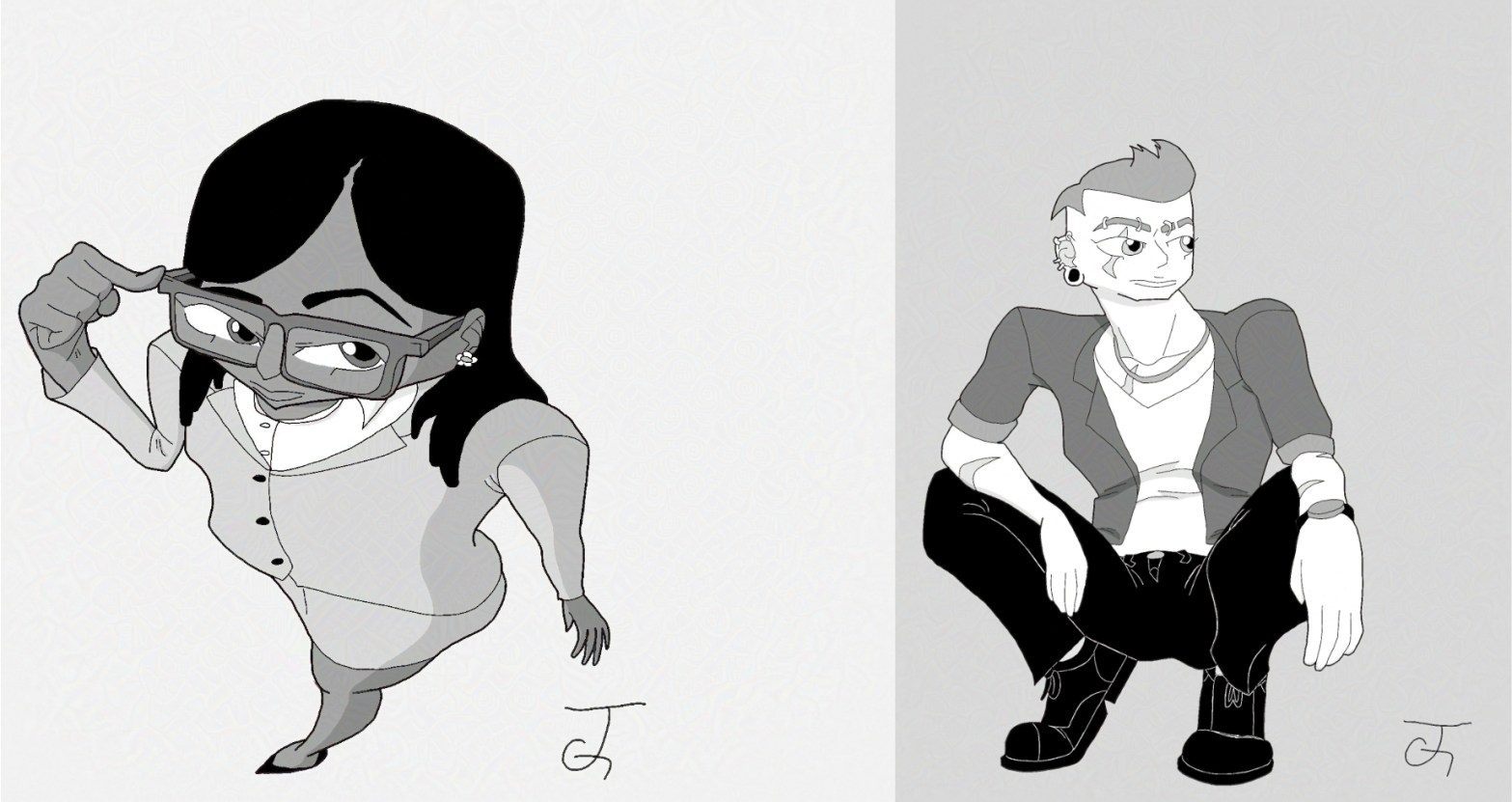
I have two pieces that I want to show off this week. First is the new draft of the Lea pic I made last week. I feel confident in having improved the perspective I was going for, and I was right to think that having her other arm down would look sharper. I love how her figure came together and having two hands at different levels in a shot like this. The second is an illustration of Fish squatting like a cool tough person. Yes, her name is Fish. I really enjoy this one because I didn’t have much of an idea or desire when I started out. I put on some music, it occurred to me that I should draw Fish, and then I picked a different challenge than what the Lea pic gave me. It all come together really well and felt great in the moment; it felt like I was applying the lessons I’ve learned lately with ease as I guessed around how to best put together the pose and skeleton. I struggled a bit with the angle of the feet, but I think I got it in the end. And with both of these, I did a line weight thing! I think they look much sharper that way, and it’s fun to figure out how to use different line weights. The outlines are in 3 pixel, and the details in 1 pixel. The one thing I do kinda regret is that Fish’s pants are black. Black is the right decision, but it’s also one I made after I did her arms and certain parts of her leg in 3 to emphasize the crossover and position of them, you know? That detail is lost in a black fill. Live and learn.
Ok, I’ve been itching to talk about these big art ideas I’ve had for a while, and I think I finally have a good vehicle for getting them out: Megalopolis, a movie I haven’t seen. I’m not sure if I want to see it, really. It seems like one of those experience movies, but like, I can’t tell what it’s about based on the trailer. Society is bad, there’s an architect, the Soviets are probably an issue, and a statue comes to life? I get that it’s a sweeping movie about a lot of big ideas, and that’s basically the whole picture. Does the architect have a specific problem he’s trying to address? Are his buildings going to be so neat-looking that we get universal healthcare? If the issue is how our society is run, should we be focused on the Soviets at all? I ask that last question because it seems unlikely to me that the movie is going to be about how we need socialism and framing all socialism as equal to the Soviets is an age-old scare tactic to protect capital. And I know I’m saying a lot based on trailers, but it’s also not asking a lot to see one specific conflict in the trailer that the audience can wrap their heads around. Who is the architect up against? What’s going on?
That’s the thing I get annoyed with about these kinds of “real art movies,” the ones people brag about being true cinema, filled with grandeur and wonder, asking the really important questions. Because like…it’s fine if all this movie is going to do is present us with a question and explore how difficult it is in a way that reflects society. And I agree that this society isn’t the only one available to us; when I say that, I also have a lot of policy proposals that I believe in, and I’m fine if this movie just has a general thrust. But at the end of the day, movies are about things, you know? It’s not enough of a pitch to say, “This movie is about big, romantic ideas,” because we all have big ideas when we sit down to make art. Having big ideas is the easy part. The reason pop movies often aren’t about those sweeping, romantic ideas is because it’s hard to execute a movie that’s about, like, everything, man. A simple, clear idea, bare bones, with a knowable and easily explained conflict is way easier to make, and that’s what you use to pitch to audiences. I’m all for building out much bigger ideas from that skeleton and finding ways to weave in other themes throughout a movie, but it won’t be successful as a piece of art unless you know what you have to execute and get it done. Assuming Megalopolis has that, they certainly aren’t showing it in the trailer, so I’m not sure what they want me to see except for a “real art movie.”
That’s what annoys me about it right now, without seeing it. So much crap is thrown at “low art” like the majority of movies, TV shows, comics, and really any art that most people enjoy. The high art/low art divide comes down to class, with older, more exclusive forms of art being regarded as higher value or more true as art. That “high art” aesthetic is, itself, based on rich people copying what kings and queens were doing for hundreds of years, regardless of their own tastes or what art is currently available. The idea of high art and low art is a framing of the issue that completely misses the point that I think, being charitable, people are trying to make. I’ve had a few experiences this year where it’s gotten into clearer focus the difference between the average producer-led movie and a director-led movie. While I don’t expect the next MCU movie to cost $10 mil, it’s also pretty obvious that they could make a better, more creative movie for far less money if they weren’t so producer heavy. It’s a valid and important criticism in today’s late-stage capital Hollywood. You know what’s not a valid criticism? Saying that MCU movies don’t qualify as art, that they’re destroying Hollywood, and proclaiming that if we get rid of Marvel Studios, then art will be saved. Anyone who seriously believes that should not be taken seriously. Marvel movies might not be the most personal art pieces ever made, but the people who made them cared and wanted to make the best movie they could. The MCU became the banner example of what Hollywood wanted in this moment in time, but they’re not the only thing they could have done this with; Star Wars and Avatar are right there, and if they weren’t, they would have made them. There’s also plenty of “real movies” being made every year, and you can support them and talk them up on social media, regardless of the amount of engagement it gets you compared to bashing Marvel movies.
For superhero movies specifically, it feels really crappy. For a long time, superheroes were in a spot where everyone knew the basics and identified with the imagery, but they were still largely regarded as being for babies and nerds. No serious adult was allowed to like them. Everything about them was a point of ridicule. Their dominance of the comics market spread that reputation around to the entire medium. Then, once Marvel Studios solidified their franchise, superhero movies became the dominant form of blockbuster movie. Superheroes were finally openly popular. The response? It’s a terrible sign for our society that they’re popular. We’re in cultural decline! They’re ruining art! There’s never been a time in history where superheroes were just a regular part of pop culture, or at least it’s easy to feel that way. The traditional bullying victim from last century carried around Superman comics, and today, even as they have a day in the sun, they’re still facing the same flavor of ridicule.
And it all feels very performative, right? At the end of the day, whether or not you think a piece of art is good is based on if you liked it. If so, you’ll come up with all sorts of reasons why it’s good, regardless of the level of craft; on the other side, it’s possible and not uncommon for well-crafted art to end up being bad because it fails to connect with people. The high ideals people assign art give us these big, grandiose expectations about it that most, if not all, art simply can’t live up to. And what qualifies as “good”? It’s common for people to say they like “bad movies,” that there’s, “good taste in bad taste.” But what if there isn’t bad taste? What if you liking a movie means it’s good, and it’s level of popularity or craft doesn’t matter? What if art is an experience, and the thing that matters is what it means to you? What if we didn’t all have to pretend like Moby Dick was good just because a professor told us it was? Maybe, just maybe, the way we talk about and teach art isn’t in the best interest of developing good taste, because it’s influenced either by a classist view where the privileged dictate good taste to the masses or the view that popularity is the greatest reward and metric of success. Maybe good taste in art is, by definition, highly individualistic. I get that we all want to tell everyone about the art we like and convince everyone that it’s as good as we think it is, but that’s still an individual opinion. It kinda really sucks that we use metrics like popularity and acceptance by cultural elitists to enforce conformity for taste in art, and punish people who cross those social boundaries by having dissenting opinions. It kinda sucks that we bash people for having low media literacy, like it’s their fault movies have gotten worse, like it’s their fault they were born into a social class and area that doesn’t provide funding for art and literature classes. It doesn’t make for a very good kind of society. Is this the only society that’s available to us?
Weekly Art Blog 9/29-10/6/2024
 Life in the Gutters