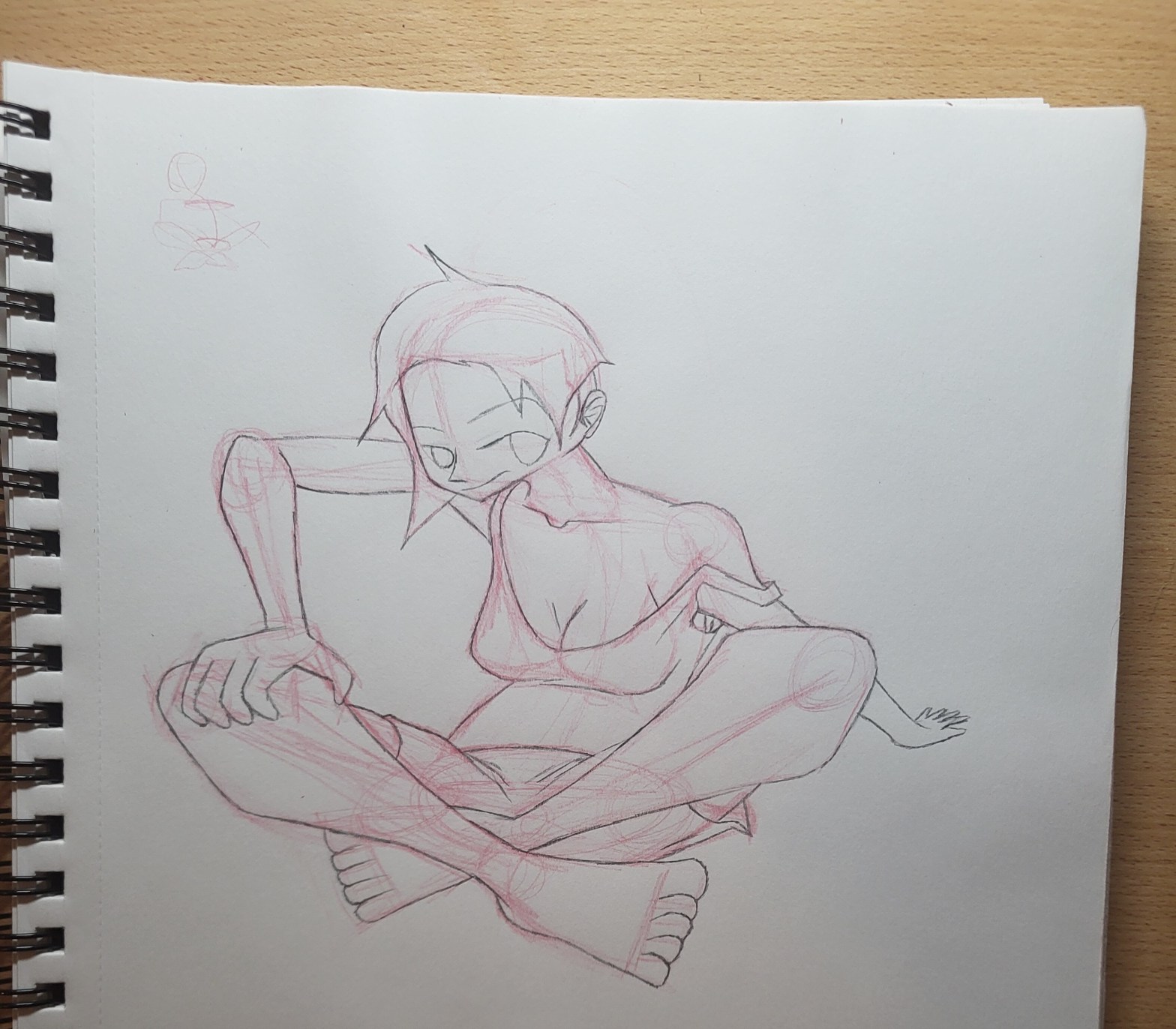
For the past week, as I struggled to get through retail Christmas, I have been focused on breaking the plot of my graphic novel. I’ve gotten to a point where I’m just about ready to start working on thumbnails, and it’s such a massive project that I’m getting antsy and nervous, so I just really need to know what it’s going to be. And I think I’ve gotten it down pretty well at this point. I still have room to tweak some things or add a bit, but I’m pretty sure I have enough scenes to accomplish the story and reach the 80 page minimum I set for myself. So I feel good, since I can now say I “know” what this book will be, and can get into planning in the near future. So all that said, I didn’t work on any big illustrations. Last night, I stretched my legs a bit, so here’s a pencil sketch photo.
Earlier this week, I was thinking again about Americans saying that American shows, like RWBY, are anime. To me, it’s an obvious no. They’re American animated shows, commonly called cartoons, or perhaps an animated series; they’re “anime” in the sense that anime is the Japanese word for that medium, and that’s the medium they are, but they’re not “anime” in the sense of what Americans mean when they say anime. The reason we specify if an animated show is an anime or a cartoon is because of the cultural specificity. We could just call them cartoons, after all; in common American English, that’s what they are. Anime is made by Japanese people, for a Japanese audience, with Japanese techniques and sensibilities, pulling from Japanese traditions. That’s what makes it distinct from an American-made cartoon. No amount of cribbing art styles, character dynamics, or tropes will make an American thing Japanese. Like, this isn’t a superficial gatekeeping. It’s the recognition of the fullness and foreignness of another culture, history, language, and people. Trying to reduce that to “big eyes, small noses” is really disrespectful and misses the point. This isn’t like saying you aspire to make a shonen action story a la Dragon Ball, because that’s a genre of storytelling that anyone can participate in, like how My Hero Academia is a superhero book. “Anime,” to an American audience, is a Japanese creation in a particular medium.
And if it’s not clear by now, I’m not trying to scold anyone for bad intentions or some moral failing. I’m a manga and anime fan myself. I’m inspired by it, have pulled some elements from the Japanese art I like for my own style, and want to see more American things take cues from what they’re doing in Japan. I know what it feels like to be the outsider, to not fit in, to have nowhere to go in this society, and how liberating and affirming it feels to find something else “outside” that makes you feel seen. I know how great it is to find community through that shared passion. But I also recognize that Japan is another whole country, and if I really like the books I’m reading and shows I’m watching, I can make my own here, and make it my home. I don’t have to claim I make manga for my comics to be what I want or to mean what they mean to me. Like, I’m honestly not fully sure what makes people want to claim such things, because I don’t know what my work somehow spiritually qualifying as Japanese would do.
RWBY openly takes a lot of inspiration from anime. Like many anime and manga fans, they were inspired to make something for themselves. You can see the love and appreciation for anime in every frame. I am not caught up on it, but I do remember quite liking what I saw; they made a good cartoon. Taking the extra step of calling it anime crosses a different boundary, one that’s fully unnecessary to cross. The show is no less successful in its artistic pursuits if we recognize that it’s American, right? Why call it “anime,” when the only reason we regularly use the word is to specify that a cartoon is Japanese? Why does it matter to people that it holds that title, like a championship ring? Like if we try hard enough, we can usurp other cultures of the ability to make things by their culture? Because that’s what the argument is ultimately about, whether you realize it or not, and I’m saying this because I assume the majority of anime fans don’t want to be making that argument. Like I said, I’m on the same side, and I apologize that my words likely come across as harsh. I just think it’s important we openly say and recognize these things.
For whatever reason, it’s important for anime fans that American shows can be called anime if they, you know, “look Asian enough.” So people have asked Japanese people if RWBY and others are anime. The answer has been yes. To continue this point, imagine the following. You’re a white person who wants dreadlocks. Everyone in your life tells you that it’s a bad idea, it’s cultural appropriation. You get defensive and mad and still want to do it, so you ask a black hairdresser if white people can have dreads. In this case, the hairdresser says yes. You go to your friends and rub their noses in it, because you’re right and they’re wrong. In that situation, you’d be a jerk, right? Not just because of the spiteful attitude, but because you didn’t actually prove anything. You didn’t do a deep dive on black hair, white hair, the history of white people taking on black hairstyles, consult cultural experts and scholars, or do an analysis with any data to come to some conclusion about the validity of white people wearing dreads. You just wanted to wear a hairstyle associated with another culture, decided that your desire gave you the inherent right to claim it as your own despite any other context, and then used one person’s word as a cudgel to fight off any criticism.
That’s what it’s like when Americans have asked Japanese people if RWBY is anime. It’s an American production, made English language first for an American audience. Even the elements inspired by and pulled from anime are the things that most appeal to an American audience, as decided by one. They’re cartoons, by common parlance. Also, I have to point out that it’s silly asking a Japanese person if a cartoon is an anime because, as I said, anime is the Japanese word for cartoon. Like, duh, you’d call it the thing you call that kind of thing. I can and do call Dragon Ball a comic. It doesn’t actually prove anything. There isn’t a way to “get permission” with this kind of thing.
The quest to claim that American cartoons are anime is ultimately rooted in racism, though not necessarily the way you may be thinking. There is a colonial mindset involved, which comes from Americans wanting to claim things from other cultures as our own. We identify with things from other places so much that we want it to be ours. It’s not enough to enjoy it, appreciate it, and understand it; we have to own it, and have at least equal claim to it.
Why is that? Well, probably because we don’t have a unique cultural identity of our own, in the same way. It’s something I’ve thought about in relation to white supremacists, in their sales pitch to prospective members. They find disaffected white people who lack of community, and promise to lift them up in the “Great White Race.” But what identity are they offering? Merely the concept of being superior and blameless, really. “White” isn’t a culture, it’s a legal amalgamation of European identities based on a superficial characteristic. There is no “white culture” because there is no country of “white.” So they have to offer people something, and often, as is hilariously pointed out, they offer an assortment of items from non-white cultures. There’s a vacuum in American society created by the racist structures invented to keep the rich and poor where they are; as a result, Americans who don’t fit into mainstream culture sometimes want to claim some kind of ownership or authorship of things from other cultures we identify with, because what else do we have?
I think that’s what’s going on with this situation. Like I said, I’m not scolding anyone for being racist. Rather, I think this is another aspect of how racism negatively affects everyone. American racism squashes together different cultural identities into an assortment of checklists to fulfill, quotas, and it leaves us feeling hollow. If you’re pushed out of your quota for any reason, you’re left starving for an identity. It becomes easy to accept another, and want to focus on your relation to it to the exclusion of anything else. If someone tells you that you’re clinging too hard or claiming too much, it feels like an attack, but it’s not. Your experience is still your own, without it being someone else’s.
Food for thought. If you love anime so much, consider learning more about Japan and the rich history that informs why anime is the way it is, and be equally proud of great American cartoons. I know it’s easy to feel pushed out, to have no “home” to go to, but the solution isn’t to claim a superficial understanding of another culture via pop media as your own identity. We have to fight for something here. Unless I’m somehow wrong, and anime fans have been identifying “anime” as something unrelated to being Japanese, which would be insane to me. Not all noodle dishes are pasta, right?
Weekly Art Blog 12/21-12/27/24
 Life in the Gutters