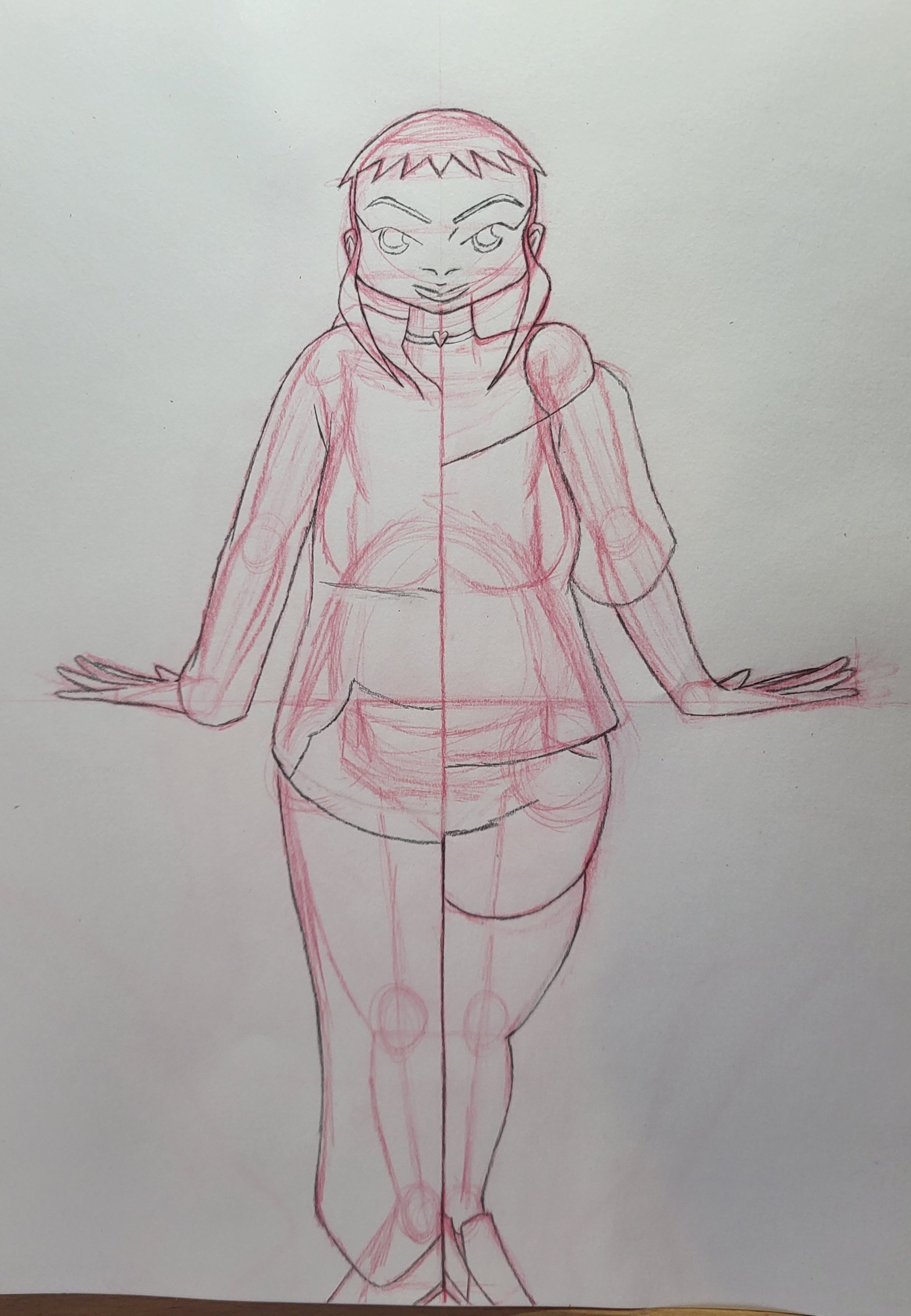
Of course, immediately after I “broke the plot” on this graphic novel, I was looking through the tweaks I was considering and realized that I was not doing what I wanted to do. That plot would have made a cohesive book, but not the book I want to make here. So I refocused it around the proper center, added the necessary scenes, and reflowed it all. Bought some notecards and everything. So now I think I have a much better plot that does the thing I want, and I’m feeling much more confident. Which of course means another week went by with not a lot in the way of big illustrations. I’m posting a picture of Rain in two outfits I did. They’ll have two distinct vibes in this book. Honestly, this is probably going to become more of a theme in the coming days, as I start working on thumbnailing and eventually drawing my pages; I may sometimes share a picture of redlines for the book, but on the whole I’ll be working on stuff I can’t share before the book is released. For my own sanity, I’ll try to take breaks to do unrelated illustrations to stretch my legs, so I’ll share those when I can.
That being said, as we enter the new year, I’m thinking about my relationship with art. To start with, to all those who say that, “Real art is a pure expression of the human soul, it challenges our notions of the world and ourselves, it brings about change and has an impact on culture,” I want to say: Shut up, no it’s not. Like, art can be those things, but to define “real art” in those terms basically means you’re saying any art that’s just fun and personal and weird is trash. Not that I assume they mean to say that, and they’d probably agree that the art they wouldn’t qualify as “real” still has value. But there’s no “real art,” in the same way that not everyone who cooks food has to be a three Michelin star chef or they’re wasting their time. I mean, aren’t these the types of people who praised The Menu as “true cinema?” Did they notice how the movie is about why taking art that seriously is toxic and sucks all the joy out of life?
Art is a sick backflip. That’s what I want to focus on. I like juggling because I like it when people like doing something, practice it for hours on end for years, and get really good at it, and it has no application to any other part of their life. Juggling comes with other competencies like hand-eye coordination, but on the whole, you’ll never be at the grocery store or trapped in a burning building or interviewing for a finance job and find juggling to be useful. It’s a skill unto itself that you pursue out of passion and that you maintain because of joy. Sure, I could do a speech where I talk about how that reflects the true nature of the human soul, about the power of persistence, about how such a pursuit is a grand act of rebellion against capitalist society. That speech would be true. But you know what? Who cares? That’s not why anyone is juggling. If you can juggle, why aren’t you at every second of the day? It’s awesome! Simone Biles is sitting at home, watching Netflix or something like we all do, instead of doing backflips. Why does she ever walk places?
When I think about this, I think about the first chapter of Green Green Greens by Kento Terasaka. In it, we meet the main character, high schooler Haku, as a shallow guy who’s too afraid to try anything because there’ll always be someone better than him. He’s countered with Oga, a classmate who’s really into golf. She is disgusted by his ignorant attitude, talking about the successes and value of famous athletes in terms of salary and how much their used equipment sells for. Haku doesn’t know the true value of what anyone accomplished because he never tried doing anything for himself. He knew there was a nearby putting range, so he gave golf a try, and hit balls for hours. Afterwards, he saw the little scratches all over the face of the club and realized what it means that Tiger Woods’s clubs have a deep indentation in the middle – that he hits the same spot every time so consistently that a single indentation could form. Haku became disgusted with his previous attitude and dedicated himself to golf.
Whenever people talk about how Important “real art” is, I think about Haku at the beginning. If you don’t know anything about art, it’s very easier to put it in big, abstract terms like how Important it is, so that you can make yourself impressed with it. And while some artists are trying to be Important, that’s often completely missing the point. No one first picks up a brush because they want to make people question what authority should hold dominion over our souls. They do it because painting is fun and cool. The Important stuff always comes afterwards. Chef Slowik just wanted to make a good burger, right?
We lead with the Important stuff to our own detriment. So many people say they simply can’t be artists, that they can’t draw or can’t paint or can’t sculpt, because their experience of art is a textbook talking about how profound the Mona Lisa is, combined with people trashing pop media as “not real art.” I’m sure DaVinci was just pleased that his brush technique and her expression turned out like he wanted; he wasn’t plotting a revolution in how people approached art and portraiture for centuries. I likely won’t be a juggler at any point in my life, but I like flipping and catching my sticks; I’ll always be dissatisfied with something about my art and see myself at the bottom of some hill, but I’ll keep drawing.
All of which brings me to the prison of other people’s eyes. A big part of art is displaying it for others to see, at least in the public imagination. The idea of judgment from others, of not measuring up to the idea of Important “real art,” is one of the biggest hurdles an artist faces. Especially in our society, from keeping up with the Jones’s in the fifties to Instagram fantasies in the present. We put too much importance on the other’s gaze, centering it in our actions where it doesn’t belong. I’m making my graphic novel for myself. I wanted to do it, so I am. As I go, like I’ve always done, I’ll think about what I would most like to see on that page if I were reading it. Any other guide is useless to me; I don’t know what some hypothetical audience is thinking, and they’re not who I’m making this for anyway. I plan to sell it when it’s done because I want to share what I love with others. It’s the same reason I have mini comics posted on this site for free. I make a thing, I’m proud of it, and I want others to see what I did. The least humble aspect of this is that I have such great taste, I’m sure you’ll love it if I love it. I’ll wear that every day of the week. What you think has no bearing on what I do. Art is a selfish thing, and ideally it should always be; it’s a passion. It’s where you find life’s joy, whether by having fun making it or being entertained viewing it.
I used to be annoyed reading the afterwards to the first volume of If I Could Reach You by tMnR (pronounced Tomonori). They talk about how their head was completely empty when making the book, unlike their friends who think hard about their intentions and themes. If you read the book, you’ll know why the idea of tMnR being empty-headed while writing that book is frustrating. But now, I think I’m finally on the other side of that. I know there’s stuff rattling around in my head, but I don’t want or need to be caught up in the abstract. I get so antsy, so frustrated, that I’m not already drawing this thing. Whatever’s inside me will end up on the page, so who cares if I know what it is ahead of time? If anything, I want to be able to flow with it purposefully, because I’m still stuck waiting to catch rain.
Weekly Art Blog 12/19/2024-1/4/2025
 Life in the Gutters