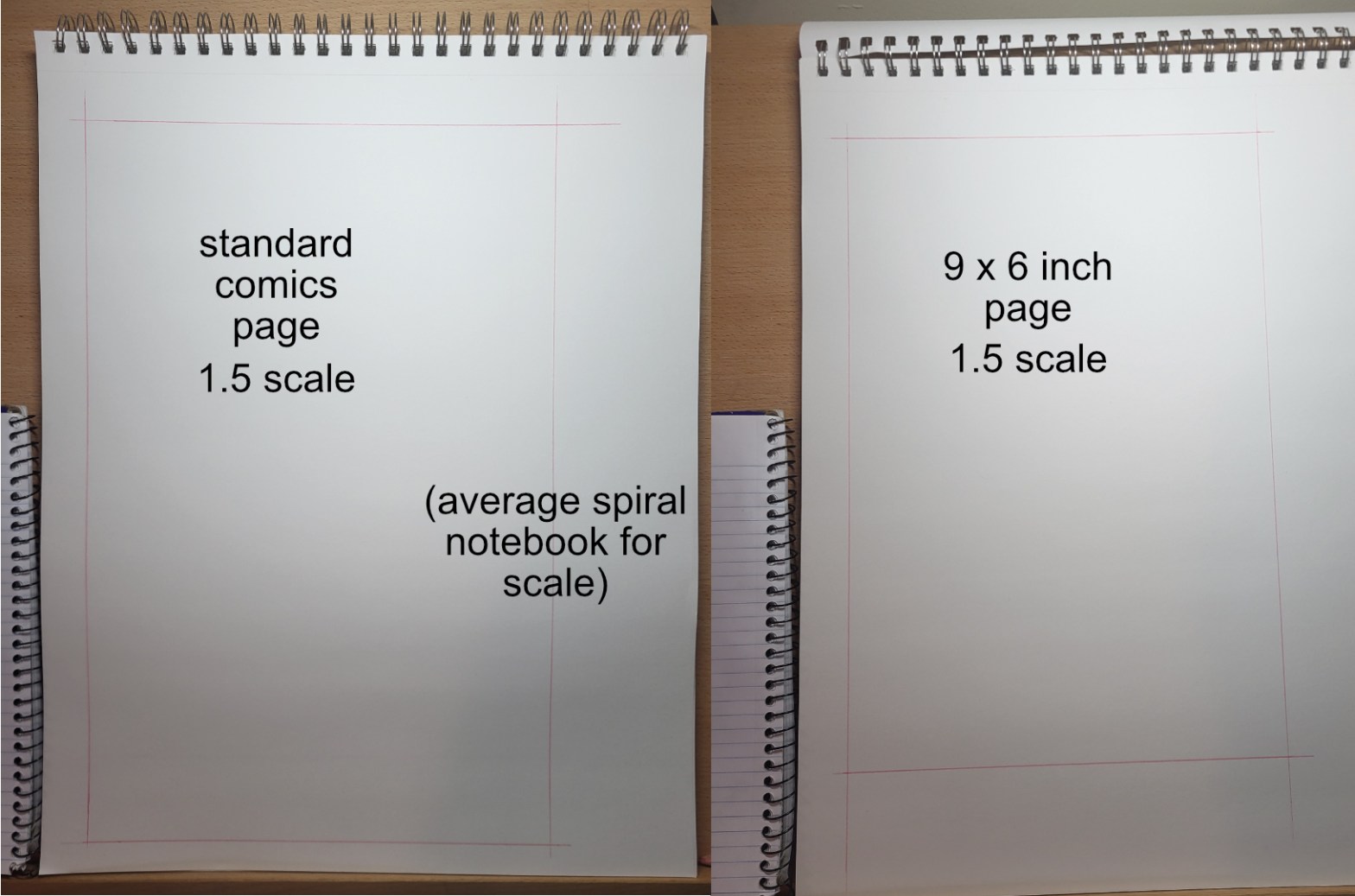
This week’s post is in a different format than usual. I wrote a whole thing on Sunday morning. I knew I was going to follow up on stuff later in the week, so I have a couple updates below. It’s a long one, so stick with it. As for drawings this week, I have been doing thumbnails, so nothing I wish to share. Posted with this are sample page sizes, discussed below. I was flipping through a notebook and found a monster I had made whose gimmick was having a really, really long tail, and I want to draw them again. A little heads up for the week ahead.
Sunday: I’m in a daze as I write this. I’ve recently started thumbnails for my graphic novel, and the page I’m currently on has me thinking about formatting. I knew going in I wasn’t going to be drawing this on the same size page I’ve had in mind for my zines. I’m bouncing between making it standard comic size (10.25 x 6.625 inches) so it feels like a “real comic,” or doing it at a somewhat different size, as like an aspirational thing about how comics should be made; the alt I have in mind is 9 x 6 inches, and I have a copy of Sabrina the Teenage Witch by Kelly Thompson and Veronica Fish on my bookshelf at that size. Either size is big enough that I have to think about scaling differently. If I do it at scale, the art may not come out as good, but also I’m going to have a digital component, so the final line art will be done with a zoom. Does that matter? If I wanted to scale it up, the page might be too big for me to comfortably draw on, and certainly too big for my home scanner and easily available paper. Of course, all this is relevant because page size affects panel size and the amount of dialogue and other text I can fit in a page, which I need to know for planning.
All of which has me thinking that I should consider looking at printers and printing considerations early, so I know I’m making this right for the final product. I have no idea how to locate or evaluate printing services. So in looking for info on that, I checked out a couple blog posts from Lifeline Comics, whose emails I get from doing their Bi Visibility Kickstarter. I didn’t find the topic of printing like I wanted in those posts, but I did find them talking about how to find success with webcomics on Webtoon. It’s the kind of thing that always makes my head spin, because I have so much trouble processing the amount of work, time, effort, and energy required to do all the things I’m assured I’d need to do for even baseline stability.
Like, I would love it if all I had to do was make comics and I could live a happy life and be taken care of. To do that, I’d have to become a master of online marketing and social media, produce an ongoing body of work on a regular basis, and also manage multiple business ventures, all while doing as many in-person events as I can and making time to interact with fans. Or so they say, if webcomics are part of my plan; I tend to assume they know what they’re talking about, but I also haven’t seen other accounts with a different path. Maybe a print career would be different, but the details of what that looks like are even murkier for me, and I’m sure no less daunting. It reminds me of the Mitch Hedberg joke about asking a chef if he can farm.
I was never a free spirit, so I didn’t leave home to throw myself into my dreams and eschue conventional life. I barely function in a life with outside structures, and I’m struggling everyday with not having a social circle and thus the kind of support and connection I actually need and want, and struggling with not having a pathway in my mind on how to change that. Wanting to resolve that feels like as much a life or death dilemma for me as being able to pursue my art dreams, and both are things I feel I have to do right now or else. Either way, being able to survive, comfortably so, has always been high on my list, and getting there is more doable, even if I don’t like what it requires.
I got a job and went the “normal” path in life, and I’m not in a position to leave that job so I can find new and exciting ways to exploit myself to gamble on an art career. Even if I tried, I’m not convinced I have the mental or emotional ability to produce work at the necessary rate, with the way people describe it. Outside of Internet hustle culture BS and capitalist productivity doctrines, I want to be able to make more art because I have a lot of art I want to make and I get discouraged thinking I’ll never be able to make it all. I’ll definitely never be able to do so if I’m stuck at a job and have to dedicate most of my life to something other than art. So I’ll never have time to rest or find friends and relationships, and I’ll die tired and alone and unaccomplished.
What size page should I be planning on for my graphic novel?
I just…Life is so hard, you know? I’m constantly dipping my nose in and out of the water while everyone tells me I’m doing great and see no issue, and I don’t know how to communicate my needs or help myself with most of this. In the immediate future, all I can do is take stock of what’s in arm’s reach. I plan to fully produce this book before I even start with funding considerations for print. I want a printed comic above all else, so I don’t really want to focus on possible webcomic options. I can make all the little Kickstarter or Patreon or whatever else extras when I do the print funding campaign. Doing that for every book I want to make would be a slow and difficult process, but you know, maybe that’s my path. I can’t really wrap my head around any of that until I’ve done at least one thing. I also have been realizing over time that I’m more capable than I think. A New Year’s resolution for me is to come to terms with my negative self-talk and remove the internal obstacles I have. A lot of my stress and anxiety has to do with how I view myself and imagine others, and I can address that.
And I can draw a sample page to see what I want and what works. A redline layout and a few words written at the desired size would be enough to know what fits. Enough of an idea to keep working and rethinking what I can do, at least. Maybe I should search for printers so I have a cursory idea ahead of time, but honestly that’s a different day. I’m not researching business needs right now. Maybe what I think of as “industry standard” is the safe bet, but I also saw a stat that we sell four times as many kid’s comics as we do superheroes, the supposedly dominant genre, so maybe I’m wrong. Just small steps today, that’s all I can do.
Bonus digression: I went to the Wikipedia page on comic books to find the standard page measurement and where it comes from. In so doing, I also saw some stats that blew my mind. Like, not surprising that it’s the case, but I didn’t know it was that stark. The info isn’t fully up to date, and I know it’s Wikipedia or whatever. It said the manga market in Japan is like seven or eight times the value of the American market, and that manga in America sells three times as much as superheroes; that’s also where I got the kid’s comics stat.
I keep thinking there’s something unhealthy, stagnant, and even declining about the American comics market. Then I hear experts and business types talking about all this growth and these robust numbers and signs of health in the industry, and I think maybe I just don’t know enough and things are better than I imagine. Maybe what’s actually happening is a difference in perspective. All those people saying things are great and thriving are likely comparing things to where the industry has been, because they’re keeping up with the numbers year by year and remember the nineties crash, whereas I’m thinking of where things should be. Japan has half our population, they shouldn’t have eight times the market we have. What are we doing wrong? You know, besides being sequestered almost exclusively in specialty shops many find intimidating, embarrassing, or outside their interest; relying on the sale of monthly single issues as the main source of income, such that actual, literal books are an afterthought; and catering all publishing decisions and business strategies around the interests of two IP farming giants and the fans of their books. I mean, when your strategy is to best leverage the buying habits of an insulated minority seeing little growth, what else would you be doing?
Update: I wrote the above on Sunday morning. That afternoon, I made and was reviewing those at-scale sample pages I discussed. They’re both remarkably similar in size to the scaled up zine pages I’ve been working on, so it looks pretty familiar. Seeing the text on that scale does help make it feel big, though. It’s not clear which of the two is better or more desirable from that, so what I really need is to see what paper is available to me and how I would be using it. The difference in size between the two when scaled up for layouts is big enough that I may decide by materials.
So I’m pretty decided that I can fit more stuff on a page, and I think I know how much, generally. The big factor for planning now is about pacing. I’ve always tended towards having relatively little dialogue and actions in each panel because I like to keep the pace smooth. I also generally don’t like when there’s dialogue that fits two or three emotions in one panel; it’s similar to how I don’t like when characters talk and their mouths are closed. So every time I add a line of dialogue to a page, I think about how many other panels I need to add to demonstrate that new beat. If my page is bigger, I can do more panels, and I need to decide how many is too many. For my zines, I never wanted to go higher than 6 in almost all cases. 9 x 6 might still be at 6 panels, maybe 7, since the area is similar enough. I could go as high as 9 on a standard page.
So I’ve got some thinking to do. I’m also generally feeling better about my future at this moment (you know, pending the inauguration; really dark irony that it’s happening on MLK Day). As I work on myself and find the limits of what I can do and what I want to do, I’ll have a better idea what my career can look like. I know I’m a long ways away from pitching to a publisher. Looking back at those Lifeline blogs, it’s clear to me they’re being the cheery voice explaining how the terrible webcomics infrastructure wants you to operate. Like it is just hustle culture nonsense. Not because I think they’re acting in bad faith, though. Some people can do what Webtoons and others want, and they want to reach as many people as possible. That’s fine, and for them, a positive take on all the “opportunities” available is good. But also, they’re literally just describing how Webtoons masquerades as a platform while using powerful incentives to control format, themes, genre, and content decisions by creators. Platforms don’t have that kind of influence. They’re basically publishers, because all internet platforms are publishers soliciting free labor from the public to generate their profits; a minority of creators earning ad shares isn’t really a solution to the big money problem of the internet.
Thinking of all this internet stuff is convincing me that we need stronger and more diverse local art scenes, and greater regionalism. Everyone wants to make stuff and share it, and as things stand, you’re either an unknown or you’re fighting for national and international notoriety. If things were better and everyone could pursue what they wanted, we’d only have more voices drowning each other out in the vast sea. It would be nice if there was an in-between step. Using the big leagues metaphor, it seems like we should have minor league arts, as well, to a much greater extent and for more arts than we have now.
And while I’m doing this, I do want to say I like comics shops. I’ve quite liked the ones I’ve shopped at. My desire isn’t for them to go away, and I don’t think selling comics in other stores would destroy them. They’ll still have their dedicated base of comics fans and will be the heart of the comics fandom. It’s just one of those obvious business things where we should also want to reach people outside of that dedicated fandom. Share what you love rather than hoarding it. Instead of leaning into the idea of the comics fandom as a niche community, we should be selling comics that appeal to everyone; we all watch TV and see movies, or at least YouTube and TikTok, so why wouldn’t we all read a comic or two? The future I’m imagining isn’t one where Marvel and DC move out of LCS’s to Walmart; it’s one where Walmart is stocked with soap opera and sports comics, the sorts of currently underserved genres that I think would be popular with non-superhero comics fans. Ideally, I’d really like to see comics shops be more important as platforms for local amateur comics artists. Be part of that art minor league we need.
Update: I got myself into the store and looked at available materials. I was attracted to the Bristol board, but it’s expensive. It’s also a thing I’d primarily need for inks and pens, and I don’t intend to use those for this project at this time. So, I opted for some Strathmore drawing paper. I like the feel of it, it’ll handle pencils really well, and it’s way more affordable than Bristol. I was able to find a 14 x 17 inch pad, which is large enough to accommodate a 1.5 scale of the standard comics page. Of course, with this, I will be drawing the full page setup from scratch for every page, because I can’t just photocopy one good master like I do on printer paper. That being said, it’s definitely worth doing, because I learned how valuable and useful it is to draw on a scaled up board.
Separate from any choices for myself, I have to say: It’s SO BIG! Like, I’m here putting down the top line of the page, and I’m having to stand up to get to there. I’ll have to switch chairs or something. Like, I’m legit not used to drawing on such a large canvas, or drawing figures at that scale. It opens up more options for me in terms of drawing figures in panels at sizes that better share space with dialogue. I’ve often thought I left enough and then had trouble not covering people’s heads while maintaining eyelines.
After looking at sample pages for both scaled up sizes on my giant pad, I think I’m going to go with 9 x 6 after all. I like that it would make my book look different than the single issue magazine. I’m working in an underserved genre in comics, and I want this to look distinct from the types of stories you get from Marvel, DC, and the predominant action-mystery stuff you get in comics shops. I also remembered that, besides that Sabrina comic I have that’s 9 x 6, I also have a similarly formatted graphic novel, Anya’s Ghost by Vera Brosgol. It’s a great book, and a great example of the diversity in format that we don’t have nearly enough of here. I like nonstandard formats; I also have the pocket sized A Quick and Easy Guide series and The Private Eye by Brian K Vaughn and Marcos Martin, which looks like a coffee table book. Different formats tell an immediate story about what you’re picking up; I know that Black Lagoon is immediately different from Dragon Ball in a way that High-Rise Invasion isn’t, even before I get to the art, you know? Not that every story follows trendlines, but it’s a not-oft used tool here in the states.
A standard size comics page does still have appeal in that the bigness of the page is an exciting prospect, and I still have time and room to change my mind. Maybe it would be better to help normalize queer romance comics by making one that fits in on the racks at the LCS. I checked the thumbnails I have so far, and they could all work in either format. At the end of the day, though, with the way I’ve worked in the past and the way I think about pacing, I think the 9 x 6 is a better fit for me. I can give you another update on the topic whenever I actually start drawing pages.
As you can tell, I’m much more at peace right now than I was a week ago. I spent the week making a bunch of thumbnails and just focusing on my immediate needs, and it does help. I still have a lot of trepidation about the future, but one great takeaway from focusing on what you’re doing right now is that you also focus on how excited and enthusiastic you are for it. I really want to make this comic, and though I expect everything after producing it to be a struggle of the highest order, it’ll be worth it.
 Life in the Gutters