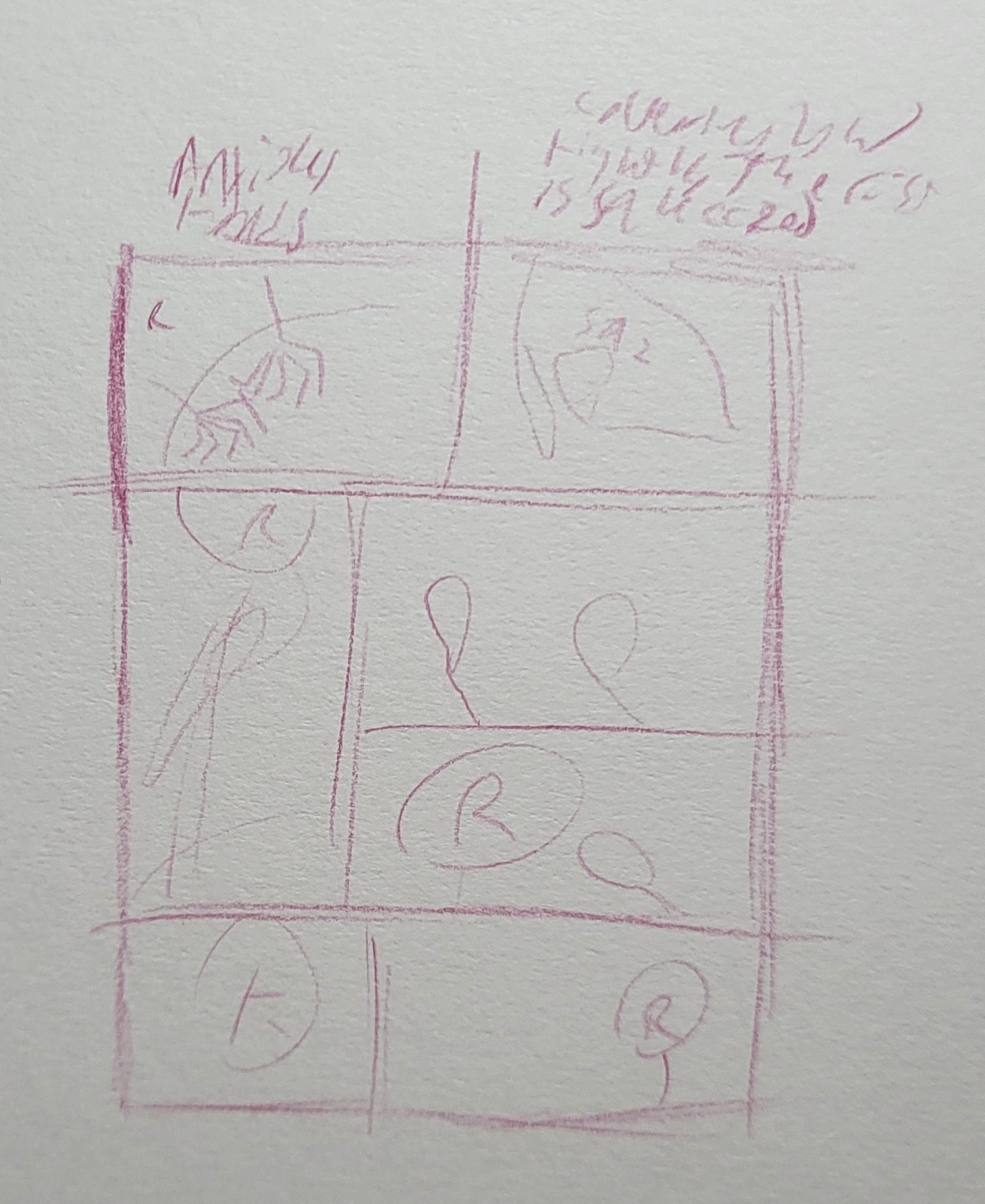
I almost forgot to write my blog. I got up and started doing housework. It’s been a really rough time at work this week. We missed a couple trucks last week, which made for easy days then, but also means we’re getting even more freight than usual because those missing trucks are being distributed to our trucks now. We’re getting Christmas levels of freight without Christmas levels of staff or sales. We’re very quickly running out of room for everything, and I’m the one in charge of that. My schedule has been changed because we got a shipment out of schedule, so now I only have one day off before going back. Looking forward to the three-day weekend I have at the end of it. So needless to say, it’s been stressful. I haven’t been drawing as much because I can’t focus on it very well. I have a hard time telling when I feel this way, so it’s been hard to be satisfied with the amount of work I’ve been able to do. I’ll be drawing for most of today, really enjoy this short moment of breath. While it’s hard to be accept how hard things wear on me, it’s also hard to recontextualize frustration with my inability to draw as passion to get to the finish line. Things only feel the way they do in the moment.
So, what to talk about…I have actually had a good little inspiration for my game side project. I’ve mentioned it before, that I’m trying to make a PvP tabletop fighting game, tinkering with it every now and then. My new ideas are centered around simplifying the mechanics more so I can focus on the elements I find most important. The big inspiration for this (I think) is watching an episode of Parlor Room on Dropout, a show where they play different board games. The newest episode was Thirsty Sword Lesbians, a narrative one-shot RPG. Quite frankly, I didn’t follow most of it. I can’t tell how much of what happened was following Sephe’s narrative, or how much improvisation went into the characters. I couldn’t always tell when they were just talking as players or as characters. The social dynamics were really confusing, because they were friends and even flirty but then were at each other’s throats, seemingly on a dime. The game mechanics were really unclear to me; I still don’t know what strings are. Like, I never thought I would like role playing, and that experience really sold that for me. It’s so confusing and difficult for me to have regular conversations, let alone whatever that is.
That said, the balance of the game is illustrative of the maker’s intentions. It’s a narrative game, with simple roll plus mechanics to give players some influence on the story. It’s not action-based, so you don’t want a ton of abilities and actions and whatnot to distract from the story and character immersion, while still allowing for agency and surprise. The most important elements in my game are character customization and accessibility. I want players to think a lot ahead of time and between battles, but then be able to get right into it anywhere. So I’m going to redesign combat around simpler roll plus mechanics, rather than the formulas I’ve made in the past (as simple as they are, they’re still math).
I also want to really take into account the “you can play anywhere” angle by making the game board live. This is a game you’ll be able to play with just character sheets, dice, and any small token to use as a character piece (even a coin). Start on a flat surface, and anything else on or around the pieces is the board. If your piece is forced off the table, that is live in the game (I’ll have to define when a fall is lethal). If someone bumps the table accidentally and knocks over something across the field, that’s live in the game (of course, don’t cheat by affecting the board deliberately). Your character could stand on a book to get higher ground, or move behind a bottle to get cover. Combined with having some way for your history of battles to carry between fights, I think that’s an exciting way to sell the game as a real living part of the world you carry with you. Imagine if your guy fell off the table and you had to throw a rope to catch the bolt on the leg, and then climb back up! I had been planning around a d20 because math is easier in 5% intervals, but now I think I’ll switch to d6 because those are more functional as a tool to measure distance between characters. Plus, simpler roll plus mechanics.
But that’s enough about game design! I’ve also been thinking about the creative process generally. As I’ve been struggling to make a comic, I thought about the steps to make a comic. Basically, I have seven steps. The first is the easiest of all, and the most accessible: Having an idea. This is the “magic inspiration” part of art that non-artists get most caught up with. It’s the moment where you think, “Wouldn’t that be cool?” I have ideas every day, and I think even people who don’t think they’re creative likely have ideas pretty often. It’s actually pretty mundane, because life is wonderful. The key is to identify good ideas. A good idea is not only cool, but strikes a deeper chord. It speaks to something you experience or think is true about the world, it helps you navigate bigger thoughts, it takes something complex and multifaceted and puts it into a singular image. Things to that effect. A good idea has a core concept that inspires other ideas, as well. It’s also important that you can do something with the idea, and that consideration takes experience, so get cracking now; you have to find out if this is something you can do immediately, or if you have to learn a new thing to do it right, and have some idea of the desired outcome. Ideas are precious and should be saved, whether or not they’ll ever be used. They often don’t happen on purpose.
Once you’ve gotten a good idea that you want to work on, you have to make mind soup. This is where the majority of your big creative thinking happens. You have to take your idea and define everything around it to create the larger piece. For a comic, that means coming up with characters, settings, lore, mechanics, plot points, all that fun jazz. Much like my advice to record all your ideas, I also suggest making as much of this stuff as possible. I put this in my notes app, even recording my logic for changing things around. I think it’s important to keep track of your logic, intent, and journey so you can see where you’ve been and where you went wrong or right. Quite frankly, I think the best policy is to have far more than you’ll ever put on the page. There’s no such thing as waste. Even if no one will ever know why that thing has that name, or the exact logic on why something works, or the history behind every town festival, all of that stuff helps you create a rich and full world for your comic. It can’t feel like it’s more than what people see if you actually do put everything on the page, right? There are times when mind soup can boil over in a flash or it can take years and years of simmering; I get the feeling that many professional artists are able to do the former more often, but all artists have the latter somewhere. I call this step mind soup because it’s a very chaotic experience, to have entire worlds swimming in your head to keep track of, and none of it is close to a final product yet. At the same time, not all creative chaos is created equal: Mind soup is made from a million ingredients, and you have to serve people a good bowl.
Step three is drafting the comic itself. This is where you have to get out of mind soup. There are a few ways to do it, and nothing is wrong. The important thing is that you end up with a plan on what you want to make, literally in the here and now. I tend to be a writer first, because my thinking is primarily words. I don’t write full scripts ahead of time, but I do like to open my notes app and talk through what’s literally happening and how to define each page. It’s more like I’m spilling some soup, really. The most writing I do is dialogue, because I’m a dioalogue person. I think about what people say and how they say them, rehearsing impressions and analyzing meaning, pretty often, so it’s no surprise I like dialogue. While the core of comics is visual, having dialogue helps me to imagine the action better. I can pair words with images and actions, which helps me decide on moments and pacing better. Sometimes, I can start with images and throw down an action sequence in my thumbnails before I write any necessary words for it. There are a lot of ways to make a plan. By the time you’re done, you should have a script and thumbnails that lay out roughly what the comic will be. That is your guide. Some people are thorough and confident in their decisions and vision, and can follow their plans like they’re set in stone. I’m the type that needs flux, so even at this stage, everything is still up for debate. I have enough to start and continue the process, and that’s what matters.
The next few steps are the actual drawing parts. Step four is redlines, step five is pencils, and step six is digital processing. How many of these steps are used by others, and in what amounts, is all up in the air. You have to know what tools and processes work for you. I draw in those three steps, starting with red lines, or the under drawing. This is where I start with circles and stick figures and build out the rough outline of the picture. And I do mean rough; once I get past the panel layout, this all starts out as me swirling the pencil half a dozen times (at least) to make the base for a head. I’ve been burning through my Crayolas because my erasable reds kept breaking as I sharpened them, and turns out Crayola works just as well. Eventually I’ll have to use a different color. I do this and pencils, or drawing the pencil art over the red lines, back to back for each page as I go. If I did all the roughs at once and then went back to pencil, I wouldn’t know what’s going on. I’m doing this drawing on large drawing paper and with a mechanical pencil. Drawing bigger is easier and can help minimize flaws when scaled down. Once I have the pencil art ready for all the pages, I scan it into my computer and make the final art with Affinity, my drawing program of choice. I honestly don’t have a lot of experience or expertise with those programs and still don’t know what the word “raster” means, but I’m satisfied with Affinity. There, I redraw over my pencil drawing with digital lines and fill everything in with colors. Though I have worked with color before, I prefer black and white art, and will continue to do so for a while, at least. Color is so hard and is this other world of art that I have trouble entering, so keeping to gray scale is a lot easier on the brain and lowers the number of decisions to make. Step six is also where digital lettering happens.
Step seven is bookmaking. In many ways, it’s the most exciting, because you get to take all those pages you’re so happy with and put them together as a single piece. You get to see if you scaled it right, and if it’s all going to come together like it’s supposed to. Once you’ve gotten the book document together, you can print it out and see your book, in the flesh! You have become a successful artist, here defined as an artist who finishes what they start. You can then move on to attempting the more dangerous task of becoming a financially successful artist who gets to continue living and make more art.
So yeah, that’s what I’ve been thinking about this week. I’m stuck in the steps four and five dance with the second issue of my zine, and I intend to move onto step six with all five issues at once. I draw interior pages before I draw covers so I know what book I’m introducing. Having gone through so many iterations of this idea and having seen finished pages of one version, I’m confident in what I’m making now. I just gotta take a deep breath and keep working on it.
 Life in the Gutters