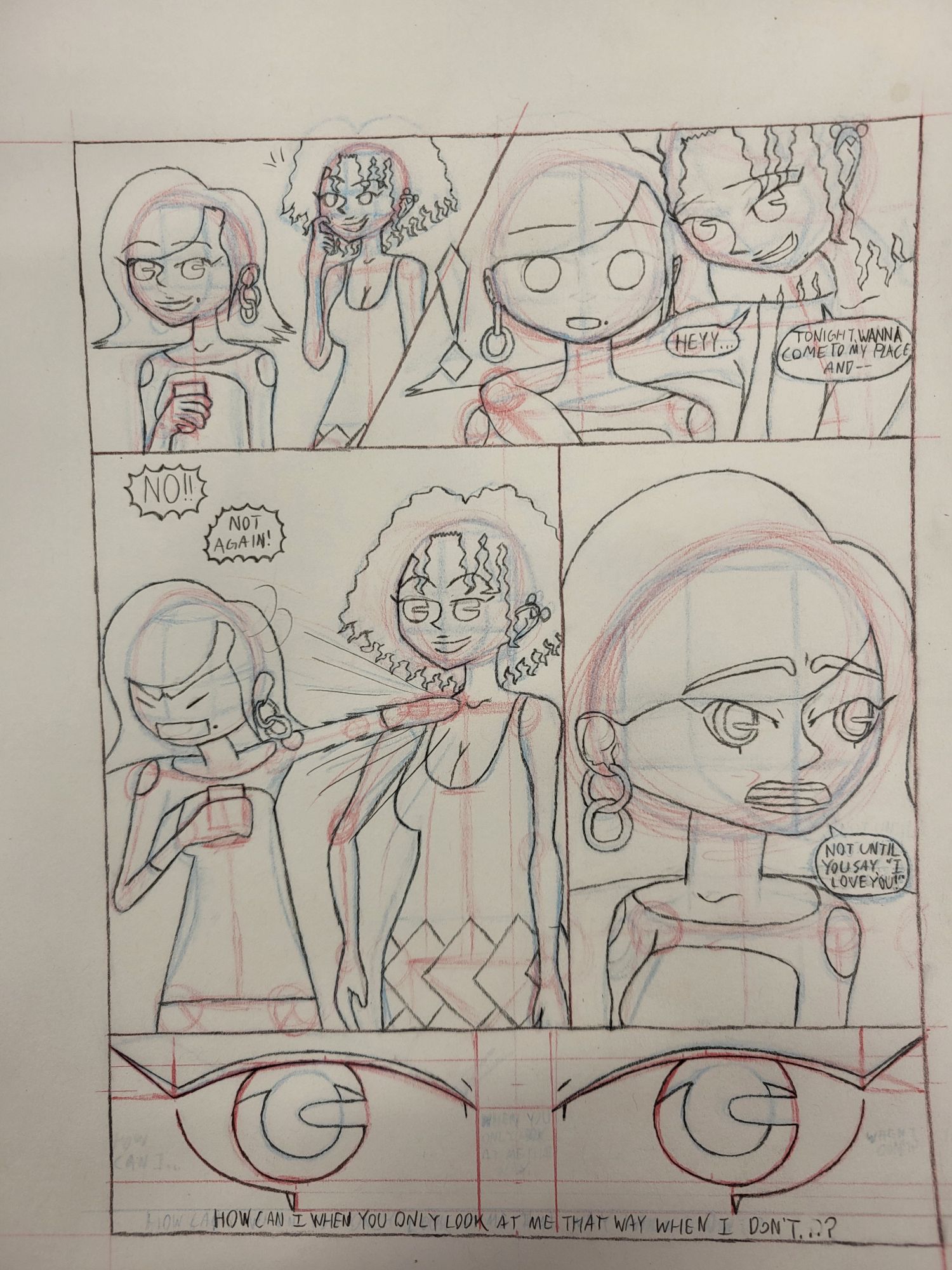
This week, I’ve completed thumbnails on Bet Your Sweet Bottom’s second draft, and I’ve broken ground on new pages. Instead of showing a new picture I’ve drawn this week, I’m going to repost a picture I drew a while back that I found while looking for reference. It’s a sample page I drew of Dom and Gabriel from Do You Really Care? My goal with it was to practice cartoony elements. Finding it again, I realize it’s still one of my favorite pages I’ve ever drawn. It’s not great as a standalone story, I just really love what I was trying to do there and what I was able to accomplish. Yet another thing to keep in mind as I think about the new draft of my graphic novel.
I had a couple other things I was thinking of writing for this week, but I don’t want to anymore. So instead, I’ll wonder aloud about people complaining about sequels. It’s pretty common to see people complain about the number of sequels, remakes, and other franchise movies that dominate movie marketing and end up making the most money. Usually, the charge is that our entire culture and ability to produce art is in peril. All original works are going to be drowned out, and no one will be able to release any “real art.” And honestly, I don’t actually get the issue in the first place.
I’ve talked before about how the distinction between “real art” and “content” or other such terms is BS. While I get that big and broad aren’t always the best goals, those qualities also don’t disqualify the movies as art. It’s also attacking the wrong enemy, right? The issue is how studio executives, who increasingly come from business and finance backgrounds, make choices. Why are they making these choices? We all know it’s money. They want an easy, safe return, and a preexisting story has a built-in audience. Audiences aren’t betraying the soul of American culture by going to see sequels, either. I mean, of course you want to see the next installment, and most people don’t go to the theatre all the time. All of which means that, if you’re the kind of person who really cares about the future of Hollywood, you’re getting a much heavier dose of these digital wall-to-wall marketing campaigns for these franchise films than most people are getting. They’re massive marketing campaigns because the marketing landscape is so fractured now, most people are only seeing a trailer now and then.
All of which is to say, it’s not the big issue it necessarily appears to be. People in general aren’t tired of original movies. They just don’t have the time and money to go see all of them, so when they see the big to-do for the sequel to a beloved movie, that’s winning out a slot over others. Studios know that and take advantage of it to give them their safe moneymaker. Does it suck that they don’t seem to believe in original movies very much? Yeah, it does. But I also don’t think that means sequels are ruining Hollywood. Hollywood is ruining sequels, is a more accurate critique, with all their producer control and noting scripts to death.
It’s also true that there are more movies being made today than ever before, so one would expect the literal number of sequels would go up. On top of that, because this is the present, there’s a lot of movies from the past to make sequels of. I haven’t crunched the numbers, but I’d believe it if someone told me the proportion really was higher today. That being said, there are still plenty of non-sequels coming out every year. They didn’t stop making them, and they didn’t stop being good. We just don’t hear as much about them on the internet. Like I said, I would like to see studios pushing for every movie they make. Until that happens, my head goes to the obvious thing: If you want a smaller, non-sequel movie to get more attention, then you can talk about it yourself. It’s not a great solution, but then again, it is consistent with your values if you’re the kind of person making this complaint. Wouldn’t you rather tell people to go see a really good movie no one’s heard of than complain that Captain America: Brave New World was mid? Not that you can’t do both, obviously, I just usually see all of the latter and none of the former, and that seems odd to me.
Beyond all of that, I simply don’t understand why movie people seem to dislike sequels in general. Even before this moment, there was a common expectation that a sequel was an inherently inferior product. It’s a phenomenon that only applies to movies, too. I’ve heard the same people who don’t like all these sequels complain that we don’t have another season of Severance yet. I don’t hear anyone decrying “stupid, unoriginal novelists” with their eight-part series. Why are movie sequels so hated? I never understood it. Nothing says they can’t be good, and many sequels are quite good. Otherwise, how would these “terrible, culture-eroding franchises” get started?
The best idea I’ve come to is that it’s about expectations. While there are other issues with The Matrix Reloaded, a big part of the hate for that movie is that no other movie can give you the same experience as seeing The Matrix for the first time. There’s a whole ritual with going to the movies that you don’t have with most forms of pop art. You choose your movie, you go down to the theatre, you get your ticket, choose your seat (if applicable), buy any snacks you want, and then sit in a dark room with a giant screen and massive speakers, specialized equipment you don’t have at home that make it way better. I love the ritual because it would be insane for me to do anything but fully invest myself in the movie after all that. At home, I have a thousand other things to do and other life priorities overpowering my attention. While buying a book or searching through a streaming service menu can provide some ritual, there simply isn’t the same routine or investment. On top of that, movies only last for a couple hours, so they have to be really good hours; you expect and want a book or a TV show to take a long time to consume, and so having a lot more ahead of you is sweetening the pot. The combination of the ritual, the short term nature of the art, and the fact you know you can’t recreate the experience at home means you want the movie to be singularly impressive. When it succeeds, you build in these sky-high expectations that the sequel will give you that experience again, but even more. No one can live up to that. No other movie can give you the experience of seeing The Matrix for the first time. We know that intuitively, and so we instead expect betrayal from sequels.
Of course, that’s not the discourse you see on social media, is it? No one wants to use this moment in Hollywood to examine the human experience and figure out what makes art work. Movie buffs are disappointed by sequels, see that they dominate the box office charts, and then complain that our culture is being destroyed by Ant-Man and the Wasp: Quantomania. Am I picking bad sequels as my examples on purpose? Kind of. There are a lot of these things being rushed through; I would like to see Hollywood treating all movies like art instead of products, and to stand behind every piece of art they create. That’s the solution I seek in these times, not the death of the sequel.
Weekly Art Blog 2/16-2/23/2025
 Life in the Gutters