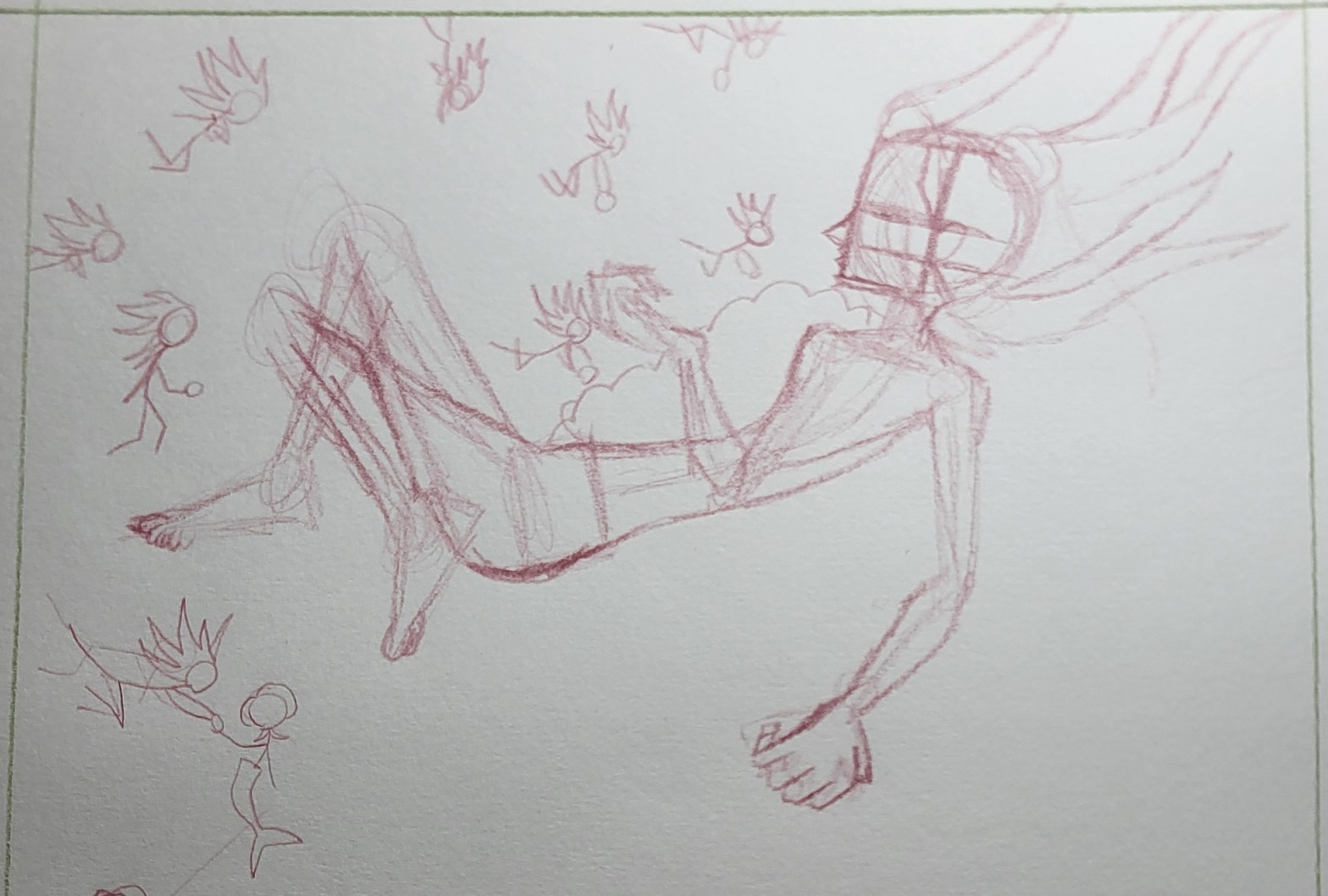
I have officially started on the pencils for the fifth and final chapter of my current comic, and I’m very happy about it. I have a lot of pages ahead of me, and a lot of things I’m going to have fun with. I’m a little frazzled because of work. Basically, they won’t get back to me about a promotion until after I go to another store for a week, and that starts tomorrow. Pretty nervous about it. They want to know if I can handle difficult employees. We’ll see how it goes.
This week, I’m continuing my series reimagining the Heisei era Godzilla films as more serious films. This week’s movie is Godzilla and Mothra: The Battle for Earth. The title already points to the messy aspect of this movie. It’s essentially a remake of the original Mothra film, but with a few key distinctions. Still wanting to recover after Biollante (a trend that will continue with the next entry), Toho brought back another fan favorite, Mothra, who is one of the only feminine kaiju and is consistently portrayed as the good monster. She and Godzilla had a versus movie in the previous series, and the two have teamed up on a number of occasions, in particular to fight King Ghidorah.
So, like in the original Mothra film, this movie begins with a giant egg being uncovered on the remote Infant Island in the Pacific. A Japanese archaeologist is sent with his wife, another archaeologist working for the government, and a liaison for a corporation in partnership with the government to investigate this egg. On the island, they meet miniature, fairy-like twin women called the Cosmos and learn the tale of Mothra. The decision is made to retrieve the egg and bring the Cosmos back to Japan, where the corporation plans to use Mothra’s egg as an attraction to make money. Mothra hatches before they make landfall, so the corporation falls back on using the Cosmos in advertisements, which they think will somehow make them rich. Mothra attacks to retrieve the Cosmos. Eventually, she recovers them and leaves Japan in peace.
Then, there are the details I left out. First, Mothra’s egg was uncovered after a meteorite crashed into the Pacific. That meteorite woke up a sleeping Godzilla and somehow caused typhoons, which then uncovered the egg. Second, the story the Cosmos tell includes a few important details about Mothra’s past. A long time ago, there was a human civilization more advanced than our own who worshipped Mothra as a god. However, they made a climate control machine, which hurt the Earth, which is a living, godlike spirit. Mothra was unable to guide the humans away from the climate machine, so the Earth created a wrathful “black Mothra,” Battra. Battra laid waste to the civilization until Mothra battled and sealed Battra away. We learn this almost immediately in the movie, before we see either insect. Third, Godzilla is in this story, seemingly because he just wants to kill Mothra, and it’s not clear why. Godzilla shows up in the water, as they’re towing Mothra’s egg, to attack her before she’s hatched, forcing Mothra to emergency hatch and fight Godzilla in the water as a newborn. The meteorite also unsealed Battra, so Battra joined the fight against Godzilla and generally humanity. Mothra and Battra eventually team up to fight Godzilla. Battra is mortally wounded and goes down with the ship to trap Godzilla below. Mothra seals them in the ocean before taking the Cosmos and going to space to change the course of a meteor that Battra planned to stop in a century when it was going to arrive at the Earth. It’s been a while since I saw the original Mothra film, so I forget how much talk of deforestation and pollution was present there; they do talk about that stuff a lot here, as references to how this movie is supposed to be about why it’s bad to hurt the environment.
A number of messy details there. Battra’s exact role and motivation isn’t super clear, since Mothra also doesn’t like destroying the environment and fighting Godzilla doesn’t punish humanity for climate change. The meteorite only serves to confuse the plot, as well. I don’t think anyone would mind if Godzilla just showed up without an event waking him. The only other thing it does is potentially tie back at the end to the meteor that Mothra promises to stop for Battra – which, how was Battra planning to do that while sealed, or even know about it? That itself is a detail included as a reason why Mothra isn’t present after the movie, since the Heisei series is pretty consistent about Godzilla immediately dispatching every other monster so that he’s the only one on Earth, and they didn’t want to kill Mothra. More importantly, the meteorite stuff distracts from the ecological themes of the film. While the original Mothra used Mothra herself as the nature being exploited, this movie keeps referring to business interests destroying nature. Despite that, it’s not clear what the corporation in the movie does, and none of their actions relate to how the monster stuff is happening. Their CEO displays a lot of childlike thinking and behavior that maybe is meant to show that greed is dumb, and certainly his plan with the egg isn’t great. Like, if this were a movie with just Mothra, it would be fine, but there’s also two other monsters here, each with their own metaphors and motivations that don’t gel with “get rich making ads with fairy women.” I didn’t go into detail before, but the movie also makes it unclear what part of the government we’re following. It’s supposed to be a ministry for environmental planning, but they’re tracking Godzilla’s position as well, and seem to be in charge of military action throughout the film. What do they do, exactly? Miki Saegusa is working with them, presumably to find Godzilla, and she goes unnamed. There’s no work done to show government failures to protect the environment, like how (one assumes) this ministry approved a bunch of deforestation projects by that corporation.
My goal with this exercise is to streamline the ecological themes and make Battra more potent. First off, I would take out the meteorite. Instead, human activity is what uncovers the egg on Infant Island. Being an American in 2025, I would like to say it’s because of a typhoon exacerbated by climate change, but I’ll stick to the deforestation angle; Japan was and still is concerned with that in a way America isn’t. So, the egg is uncovered by a landslide caused by deforestation on the island. The archaeologist team goes to investigate and finds the temple with the Cosmos and learns of how Mothra failed to save the ancients from being destroyed by their climate control machine, before she went back into her slumber. The corporation decides to bring the egg back to Japan, planning to exploit it for profit in some way; I’m thinking they should reference genetic engineering tech, like from Biollante, since that’s an easy way to get to exploiting nature and profit through medicines.
Meanwhile, Godzilla has come ashore in Japan again, attacking a nuclear reactor for a quick meal. While he’s doing that, the egg is out at sea, and it hatches. The Cosmos are at first happy to see Mothra return, but then scared because something’s wrong. Instead of their peaceful guide, a wrathful form emerges from the egg and proceeds to destroy the barge and swim away. The Cosmos name this violent form Battra, and say that the damage he witnessed humans cause the environment after the first disaster with the climate machine has caused this change. Battra swims across the ocean and gets to Godzilla, battling him for the environmental harm of destroying a nuclear reactor. Though only a larva, Battra is able to drive Godzilla back for the moment, forcing him into the water before escaping by burrowing into the ground. Battra soon reemerges in a nearby city and starts destroying it to punish humanity.
While the humans are lamenting this unfortunate turn of events, the Cosmos pick up something. Back in the ocean, where the egg sunk with the barge, another life has emerged. The egg contained a twin, and this one was the true Mothra. Mothra has been swimming to shore, and arrives to do battle with Battra. The Cosmos explain that Mothra wants to show humanity a new path, and is worried that Battra will prevent humans from ever learning to change their ways. Battra defeats Mothra and leaves to go into a cocoon. Mothra is thought to be dying, but is able to make her own cocoon. Their battle continues the next day when they emerge as adults. While this battle is going on, Godzilla shows up to get his revenge. Individually, they can keep up with Godzilla, but not without sustaining damage that, unlike Godzilla, they can’t regenerate from. The two insects are forced to team up and fight him. They are able to overpower Godzilla together and take him away. Once over the ocean, the wounded Mothra drops her half of Godzilla and leaves. Battra then self-destructs, hoping to take Godzilla with him. Mothra retrieves the Cosmos before going back to Infant Island to heal. Her final message is that Battra’s sacrifice was for the Earth, not humanity, and that their continued crimes against the Earth could unleash its wrath again at any time. There’s also moments throughout the film where Miki affirms the feelings of Mothra and Battra about humanity destroying the Earth and the warnings of the Cosmos; I’d love to have a scene where Miki is overwhelmed with grief because of how powerful and visceral Mothra’s pain is over the destruction of the environment.
This framing of events keeps the ecological themes strong by focusing on human-caused disasters, with no outside agents muddling it up. Battra being born from Mothra is a far better way to do the eco stuff, too, and clears up his role in the story. Back in the sixties, when Mothra came out, we were starting to bang the drums about the ways our modern society is coming at too steep a cost; we didn’t listen, and now we risk destruction. I also think this bait-and-switch strategy is just a better and cooler reveal for Battra. Godzilla is actually the hardest part to manage in this Godzilla movie, but I think this does a good job of continuing the concerns of nuclear energy that Godzilla ’84 started. Battra is attacking Godzilla for the potential damage of nuclear waste that the future people in the last movie said was inevitable.
I also made another important change in this rewrite, which is that I no longer have Mothra and Battra as explicitly divine. The Godzilla films are remarkably good at sticking to sci-fi themes and framing, and so I think Mothra being explicitly divine and having magic powers is the departure. Everything about an ancient insect monster worshipped as a god, with concerns about the environment, and attended to by telepathic miniature women is well within the bounds of kaiju-style sci-fi, and that’s all you need for this movie. Even the story the Cosmos tell of Mothra being made by the Earth can be a fine legend that serves the story, if the characters debate the literal truth of it by citing higher-than-average radiation levels on Infant Island that could have caused a giant monster, like how Godzilla was born. The end of the movie, with Mothra laying down a magic seal on the ocean and then flying into space because of a clairvoyant vision, is where we lose the flexibility there. Battra’s sacrifice works as well or better than the seal for how the story goes and continues, and it’s just as easy to say Mothra is out of commission because of injury (which actually is a fun backdoor if you wanted to have the Rebirth of Mothra movies happen in the same timeline as the Godzilla films, but that’s a different topic).
So, that’s what I would do here. Battra deserves to be in another, better movie at some point. I do think it’s interesting and notable how this and the previous movie both looked less good than Biollante. Speaks to how much of a rush Toho was in to rebuild interest in Godzilla, and possibly about how working with flying puppets makes it hard to do anything except shoot lasers back and forth. Next week, I’ll be talking about Godzilla vs. MechaGodzilla II, a movie that’s not actually a sequel.
 Life in the Gutters