I have decided on a Wacom MovinkPro 11 for my new tablet. It looks like it’ll be good for my needs and was within my budget. It’ll be cool and exciting to have a more dedicated machine to work with. I will be switching programs for digital art, as well, since it comes with Clip Studio Paint, so that’ll be interesting. I’m not sure if it can handle Affinity, since it’s an Android system, but also I’m disappointed to learn that Affinity is switching to a freemium version, Affinity Pro, where you can pay for AI features. I don’t care what they say, I have to assume they’re training the paid AI model on the input of non-paying users. AI developers have been complaining for a while that they need more data than exists on the internet to train their next generation of models; everything is a scam to get your data. I’ll still use the non-Pro version of Publisher to make the books, probably, but it’s sad we’ve lost another one to AI. I’m also going to have to get Scrivener or something soon to replace Word on the old laptop. A big factor in getting a tablet instead of another full 2-in-1 laptop is that all the newest ones that have the features I’d want all have AI-infused OS’s. I feel like I’m going to become one of those crazy people using satellite phones and constantly repairing a Walkman.
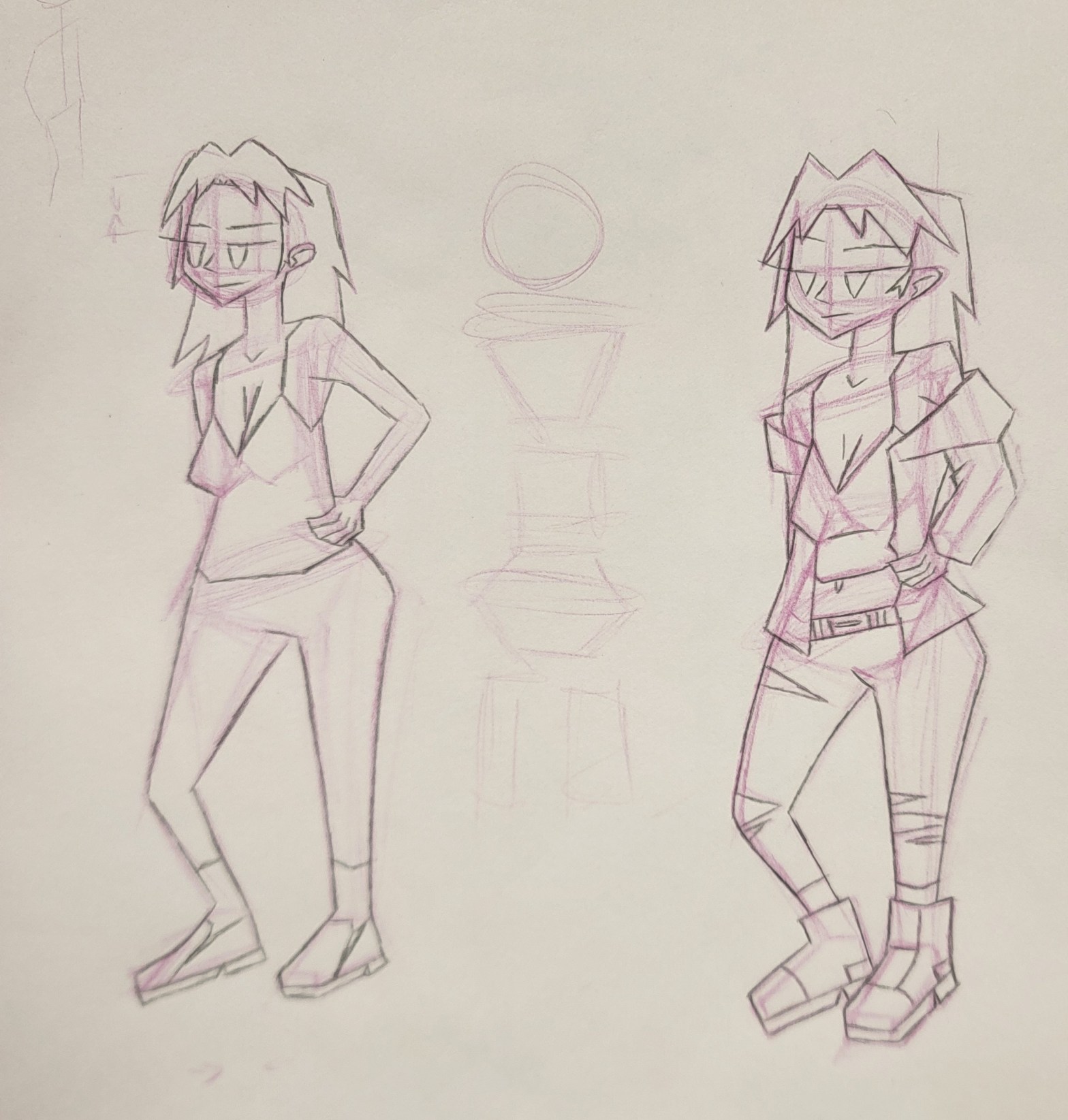
The new unit will arrive sometime next week, so in the meantime I’ll be posting more photos of drawings I did in the sketchbook. This week I’ll put up this one of a woman. I was playing around with stylistic choices. Preliminary, of course, but it generally represents where I’m trying to get my thinking. More shape-based, more cartoony. I always love when I draw in this way, and then talk myself into doing more and more and more the other way. If you’ve been reading my blog for a while, you probably know that I’m constantly circling around this same issue all the time. After I finish up this zine series, I want to stick with this other style and see what I can accomplish. I keep forgetting when I’m playing around with technique that there’s a big difference between illustration and comics, and a difference between seeing how far I can push myself to doing what those I admire do, and what I’m actually good at doing.
For the big topic, I want to talk about this article from APM Reports I read about reading education in America. It’s really good, and I highly recommend reading it. Apparently, and I don’t know how I hadn’t noticed since I attended school, but we’ve been teaching children to read wrong for decades. The main model for reading instruction is called either three-cueing or MSV, and it teaches kids to read by memorizing words as if they’re pictures, using context clues to guess what unknown words could be, and skipping words they can’t figure out altogether and fill in with what they assume it could be. It’s based on the work of a couple researchers based on observation and basically no real scientific research; the actual scientific research, as well as basic logic, refute their ideas. This is currently being taught alongside phonics, or learning to recognize the sounds of letters, but as you could imagine, three-cueing undermines phonics education by telling kids they don’t have to bother with it if it’s too hard.
If you’re like me, you’re probably wondering what I am still wondering: How is that teaching children to read? Like, what is reading, if not recognizing the sounds that letters make, constructing a word from that sound, and then identifying the meaning of that word? Words are spoken, and writing is meant to prompt that speech. I still don’t understand how else reading would be defined. As I read the article, I kept thinking that what three-cueing describes sounds vaguely familiar, as speed-reading, but you only recognize the outlines of words in that fluent way and fill in gaps with context because you know how to read slow. It’s like how a movie feels longer the first time you watch it, because your eyes are taking in all new information; the second time, your brain can fill in expected details, so there’s less processing and it feels faster. If you read enough, you come to expect certain words and phrases, and then you can do the three-cueing kind of stuff if you want to read really fast and not pay close attention. And maybe I’m not even right to compare three-cueing to speed reading, but either way, that’s not what reading is. Like, seriously, I’m still confused as to how reading is defined that, in a fully literal alphabet language like English, anyone could claim you mostly just memorize words like pictures. Letters exist to communicate sound! This isn’t a character system like kanji, it’s not pictographs.
I can’t help but connect this to so many other ideas. Like, if kids never learn to read properly, then all this book education we give them probably becomes a lot harder, huh? Textbooks aren’t worth much if kids can’t understand them on their own. They also get frustrated when they try to learn other things that don’t have shortcuts and cheat codes, like math. Really, by focusing on teaching kids strategies to bypass difficulty, you’re teaching them that learning and growing is supposed to be easy and good, not frustrating and difficult, so they learn to fear and avoid things that challenge them (not that I, as a burned out former gifted student who flipflops about art styles and has social anxiety, could see other ways to have that attitude). That extends outside the classroom to any other way you’re trying to stay informed. And if your basic framework for understanding unusual information is to memorize one specific case, guess based on your view of context, or to skip it and assume the rest, then that has to have a profound impact on how you learn and think and feel in so many other parts of life.
I’m probably jumping ahead of myself here, but that gets me thinking about AI acceptance. Current “AI” technology probably deserves the name in the sense that computer scientists have to define it in some way to work towards making AI, but it’s not actually what anyone imagines when you say AI. AI is just mindless recombination and regurgitation; it’s fancy auto-correct, with no commitment to reality. It’s baffling in so many ways that there are people treating it like the word of God, or who claim that AI generated images, videos, sounds, and text is the same as art. But you know, if people learn to read by recognizing the shape of writing and guessing around, they probably identify what AI is doing as “intelligence,” since it’s the same basic idea they were taught about how to be smart.
It’s a very American approach to learning, isn’t it? You prioritize your own individuality, your personal experiences and assumptions and beliefs, over the information being presented to you. It’s an approach that fundamentally doesn’t contend with what you see. It prioritizes the familiar and makes the novel an alien challenge. It’s an aesthetic of being smart, without the work. I’m reminded of every time I’ve seen people on the internet dismiss an argument because they’ve heard it before, as a way to not actually engage with it. They already saw a pattern once, filled in all the gaps in understanding with their own beliefs, and then took that as what the other person meant, no need for further examination or consideration. Recognizing when you do that, and breaking out of that stifled thinking, is a key intellectual tool you get from reading. Actual reading. As the Teen Titans say, “Reading is Fundamental.”
I saw a video from Generic Art Dad (which I don’t have the link to, sorry) where he described how reading levels in school are defined. As you move up from elementary through university, reading skills become a practice in examining your own thinking, considering your blind spots and viewpoint, doing the same for others, and even taking a larger look at the surrounding society that influences people. When you see it all laid out like that, it becomes obvious that reading is the vehicle that teaches you to think critically and gain deeper understanding of yourself and empathy for others. Teaching children to read by context clues and memorization stunts their ability to develop these skills by preventing them from engaging meaningfully with information on its own terms. Worse, by focusing on predictive guessing and pattern recognition, you instead teach children to lean into their blind spots and viewpoint uncritically.
This is an art blog, right? So yeah, art. Many people struggle to understand and interact with art because they weren’t taught to engage with it meaningfully. Pattern recognition and guessing doesn’t tell you what a story means, or how to feel about an image, or what a melody evokes, unless you happen to be familiar with similar pieces. Even then, it’s a narrower understanding. Going back to AI “art,” proponents often ignore or dismiss the basic idea of intent. An artwork is made by a person with a particular intent, which is the reason it exists. I don’t care if that intent is as shallow as “fun” or as deep as “[block of text],” that’s what makes it art. When you look at art, part of what you do as you examine and understand it better, is to determine and wrestle with that intent.
It’s like…have you seen that old CollegeHumor sketch about the guy who only wants to talk about hot girls? (watch the sketch and skip past here) A guy keeps pointing to women and saying they’re hot, as the whole conversation. Eventually, the other guy says he doesn’t like it because it’s as boring as pointing out the color of the wall, except that wouldn’t be reductive about the wall. (Skip to here if you watched the sketch) It’s very easy to see many discussions of popular movies and shows as people pointing to hot women and agreeing they’re hot, without getting to know them. Improper reading education is teaching people to point at hot women if talking seems too challenging. AI makes hot woman mannequins, and then you point to them like they’re human. Women continue to be ignored, discarded, and abused. Also, art in this metaphor being women receives that same treatment.
See that? Subversion! I’m an artist! I made you think I made a big long point about art to instead call out societal sexism, but really that’s a double fake, and I used my genuine concern for that issue highlighted by the source text to do a quick goof, which I’m now talking to death on a meta level you may not have recognized or caught up to since none of this is interesting enough to think about for that long! AI can’t do that, and people who learned to read through pattern recognition would think I’m being mean rather than just insufferable with this long-winded (non) joke explanation. Like, what is my intent with this explanation? Is this for true educational purposes, or is this a really drawn-out attempt at anti-humor, where it goes on longer and longer and doesn’t reach any kind of conclusion, with the hopes that eventually you laugh at the ridiculousness? (It’s the anti-humor thing, but I’m not good at it) (The previous parenthetical is a failed attempt to salvage the paragraph as a standard joke by post-scripting a crash to reality punchline) (Both previous parentheticals, as well as this one, are examples of lampshading, which I usually regard as weak humor, though in this case they may help double salvage the anti-humor)
I think I’ve put you through enough of that, since you can probably guess that I can go on. It’s important that we switch reading education to phonics, so that we can teach children how to navigate the world on their own and engage with things on their own terms. That would further help them grow into fuller people and have healthier, deeper relationships with art. It also would allow them to express themselves more fully so that they can make art. While we’re at it, expanding art education would expand children’s ability to read more things than words. It’s almost like we have this weird insistence that education has to be exclusively directly applicable to a future life activity and focus on convenience and ease, when it would actually benefit us more to treat children as intellectual creatures who can be guided through the difficult and frustrating path to fundamental understanding, which will expand their worlds and abilities far more. But what can we do? We already bought the other books!
Weekly Art Blog 11/8-11/15/2025
 Life in the Gutters